
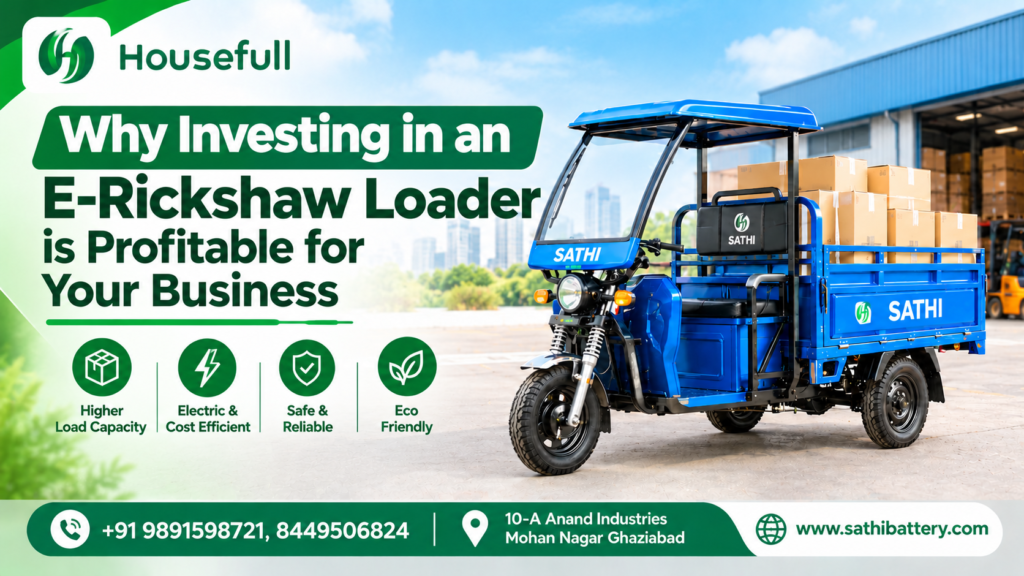
Every morning, a shopkeeper or distributor does the same sums: how many trips to the market, how much petrol, and how much of the day’s margin will go on simply running the vehicle. For small and medium businesses that move goods over short distances, transport is a recurring cost that quietly eats into profit through fuel bills, servicing, repairs and ever-growing delivery demand.
An E-Rickshaw Loader can be a practical answer for suitable short-distance operations. But profitability is not automatic. It depends on actual usage, purchase cost, electricity tariffs, battery life, maintenance and business demand. This guide helps you test those numbers before you invest.
What Is an E-Rickshaw Loader and How Does It Work?
An electric loader is a compact cargo vehicle. A rechargeable battery powers an electric motor that drives the wheels, while an open cargo body at the rear carries your goods. A passenger e-rickshaw is built around seating and comfort; a loader is built around frame strength, load capacity and easy loading. A petrol or diesel cargo vehicle burns fuel in an engine, whereas an electric loader runs on stored battery power and has no tailpipe emissions during operation.
Why Investing in an E-Rickshaw Loader Can Be Profitable
Potentially Lower Energy Costs
Electricity is often cheaper per kilometre than petrol or diesel for short, repeated trips. The actual gap depends on your local tariff, your load and how the vehicle is driven, so measure it rather than assume it.
Maintenance and Servicing
Electric drivetrains generally have fewer moving parts than engines, which can mean fewer routine services. Tyres, brakes, suspension and the battery still need attention, so budget for them.
Suitability for Repeated Local Trips
Stop-and-go delivery runs suit electric motors, which do not burn fuel while idling at a signal or during unloading.
Cargo Capacity and Delivery Efficiency
A vehicle matched to your typical load avoids extra trips on one side and wasted capacity on the other. Efficient loading directly reduces the cost of each delivery.
Less Exposure to Fuel-Price Swings
Electricity tariffs can also change, but your daily budget is no longer tied to petrol or diesel prices, which makes planning easier.
Room to Expand Local Distribution
Lower running costs per trip can let a business serve more shops or customers in its area, provided there is real demand to fill the extra capacity.
Zero Tailpipe Emissions
An electric loader produces no tailpipe emissions while running, which matters in crowded markets and residential lanes.
Table 1: Electric Loader vs Conventional Fuel-Powered Vehicle
| Factor | Electric Loader | Petrol/Diesel Cargo Vehicle |
| Energy source | Charged battery | Petrol or diesel |
| Routine maintenance | Often simpler; battery and tyres still need care | More engine components to service |
| Fuel-price exposure | Low, though electricity tariffs can change | Directly tied to fuel prices |
| Local delivery suitability | Well suited to short, repeated trips | Usable, but costs build up on short runs |
| Tailpipe emissions | None during operation | Produced while running |
Businesses That Can Benefit from an E-Rickshaw Loader
- Grocery and kirana shops: restocking from wholesalers and home deliveries. Suitability depends on stock weight per trip.
- Fruit and vegetable vendors: mandi-to-stall runs, usually early morning. Check load and route length.
- Wholesale distributors: shop-to-shop supply. Heavier cartons may need a higher capacity.
- E-commerce and courier businesses: many light parcels across a fixed area, where stops matter more than weight.
- Dairy and FMCG suppliers: scheduled daily rounds that repeat the same route.
- Hardware and building-material suppliers: heavy, dense goods, so confirm rated capacity first.
- Warehouses and small manufacturers: short transfers between units, stores and markets.
How to Calculate the Profitability of an E-Rickshaw Loader
Look beyond the purchase price to the total cost of ownership: charging, maintenance, battery replacement, financing, insurance, registration and any charging-point setup. Then compare it with what you spend today.
- Estimated daily savings = Existing daily transportation cost − Estimated daily E-Loader operating cost
- Estimated monthly savings = Estimated daily savings × Actual operating days per month
- Simple payback period = Initial investment ÷ Estimated monthly net savings
Table 2: Factors That Affect E-Rickshaw Loader Profitability
| Factor | Impact | What to Evaluate |
| Electricity tariff | Sets daily charging cost | Your local rate and charging arrangement |
| Maintenance | Affects servicing spend and downtime | Service intervals, spare parts access |
| Battery life | Largest replacement cost | Warranty terms, expected replacement cost |
| Load capacity | Determines trips per day | Typical and maximum cargo weight |
| Daily usage | Spreads fixed costs over more trips | Realistic operating days and routes |
| Financing and insurance | Adds monthly ownership cost | Interest rate, premium, registration |
| Business demand | Decides if savings turn into profit | Orders you can actually fulfil |
Table 3: Hypothetical Operating-Cost Comparison
| Item | Existing Fuel Vehicle | Electric Loader |
| Energy cost per day | ₹450 | ₹100 |
| Routine maintenance per day | ₹100 | ₹40 |
| Battery replacement reserve per day | ₹0 | ₹110 |
| Total daily operating cost | ₹550 | ₹250 |
| Estimated daily savings | – | ₹300 |
| Monthly operating cost (26 days) | ₹14,300 | ₹6,500 |
| Estimated monthly savings | – | ₹7,800 |
Assumptions (hypothetical, for illustration only): 26 operating days a month; extra insurance and charging-point costs of ₹1,000 a month, giving net monthly savings of ₹6,800; a cash purchase of ₹1,70,000. Simple payback = ₹1,70,000 ÷ ₹6,800 = 25 months. These are not Housefull E-Rickshaw prices, verified savings or guaranteed returns.
Treat payback as an estimate. Recalculate it with your own fuel bills, financing terms, battery costs and operating days.
Choosing the Right E-Rickshaw Loader for Your Business
Compare your typical cargo weight, required capacity, daily distance, motor specifications, battery type, charging arrangements, braking system, cargo-body dimensions, warranty and after-sales support. An appropriately sized vehicle is often more economical than a larger one bought “just in case”.
Housefull lists 450 kg, 500 kg and 700 kg loaders. As listed on its pages, the 500 kg loader has a 1250 W motor and a 100–120 km range, while the 700 kg loader has a 1500 W motor and an 80–100 km range. See the 450 kg loader page for that model, and confirm current specifications with the company. Our guide to choosing between 500 kg and 700 kg goes deeper. Never load beyond the rated capacity; overloading affects safety, braking and battery life.
Why Consider an E-Loader Manufacturer in Ghaziabad?
Buying from a manufacturer or established supplier gives you direct access to product information, help with model selection, spare-parts enquiries, warranty clarification and after-sales support, which matter as much as the vehicle once it is earning daily.
Housefull E-Rickshaw is a Ghaziabad-based electric mobility manufacturer and supplier, established in 2014, making e-rickshaws, e-rickshaw loaders and magnet chargers. Visit its address at 10-A Aanand Industries, Mohan Nagar, Ghaziabad, or contact the team to discuss your load and route.
HOUSEFULL E – LOADER and SATHI -E LOADER for Everyday Commercial Needs
The HOUSEFULL E – LOADER and SATHI -E LOADER range is aimed at short-distance commercial transport. When choosing between models, compare cargo requirements, battery configuration, operating range, warranty, service arrangements and total ownership cost. For a closer look at how the range suits delivery work, read why SATHI E-Loader suits last-mile delivery.
See all models on the official E-Rickshaw Loader product page. For prices, financing, warranty terms and availability, please contact Housefull directly.
Important Things to Check Before Investing
- Total purchase and ownership cost
- Your actual daily cargo requirement
- Battery charging and replacement costs
- Realistic range under working load
- Build quality and braking performance
- Warranty terms and service support
- Spare-parts availability
- Registration, insurance and regulatory requirements
- Expected demand and realistic revenue
Frequently Asked Questions About E-Rickshaw Loaders
1. Is investing in an E-Rickshaw Loader profitable for a small business?
It can be, if your trips are short and frequent and your running costs fall enough to cover the purchase cost. Profit depends on usage, electricity tariff, maintenance, battery life and demand, so calculate it with your own figures before buying.
2. How can an E-Rickshaw Loader reduce daily transportation costs?
By replacing petrol or diesel with electricity, which is often cheaper per trip, and by potentially lowering routine servicing. Savings vary with your tariff, load and routes, and battery replacement should be included in the comparison.
3. Which businesses can benefit most from an electric cargo loader?
Businesses with short, repeated routes: kirana stores, vegetable vendors, dairy and FMCG suppliers, distributors, courier operators, hardware suppliers and small warehouses. The fit depends on cargo weight, route length and daily operating schedule.
4. How do I choose the right load capacity for my business?
Note your average and maximum cargo per trip, trips per day and daily distance. Choose a rated capacity that covers your maximum load without overloading. Housefull lists 450 kg, 500 kg and 700 kg options; confirm specifications with the team.
5. Where can I find an E-Loader Manufacturer in Ghaziabad?
Housefull E-Rickshaw is a Ghaziabad-based manufacturer and supplier at 10-A Aanand Industries, Mohan Nagar. You can see its HOUSEFULL E – LOADER and SATHI -E LOADER models online and call +91-98915 98721 to discuss your requirements.
Conclusion
An E-Rickshaw Loader is worth evaluating for businesses that make frequent, short, local trips. The case rests on lower energy and servicing costs, less exposure to fuel prices and a vehicle sized to your cargo. Whether it pays off depends on daily usage, electricity costs, maintenance, battery performance and total purchase cost, so run your own numbers first.
Housefull E-Rickshaw and its SATHI -E LOADER range are a sensible place to start your comparison. Explore the official product page or contact Housefull for current specifications and pricing.