
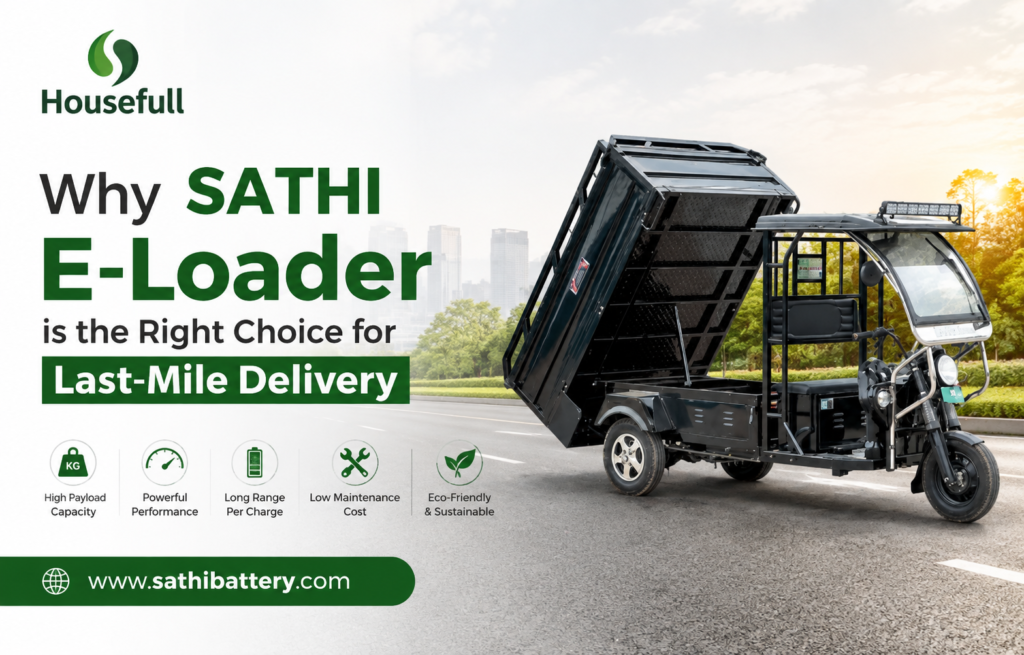
Last-mile delivery is the part of the supply chain that touches customers directly, and it’s also the part that costs businesses the most in time, fuel, and daily hassle. Whether you run a kirana store, a vegetable stall, a small warehouse, or a courier service, the final leg of delivery — from your shop or hub to the customer’s doorstep — happens again and again, every single day.
Many businesses still rely on conventional fuel-based vehicles for this work. Over time, the problems start to add up: rising petrol and diesel prices, frequent short trips that burn fuel without covering much distance, congested city roads, and high daily running costs that eat into margins. Narrow lanes in local markets and residential colonies make it harder still, since bigger vehicles simply can’t get through.
This is where an electric cargo loader like the SATHI E-Loader fits into the picture. Built as a practical option for everyday commercial transport, it’s designed around the way small and medium businesses actually operate — frequent stops, short distances, and the need for a vehicle that’s ready to go out again the next morning without much fuss.
What is the SATHI E-Loader?
The SATHI E-Loader is an electric cargo vehicle built for short-distance goods transportation. It’s part of the e-rickshaw loader range offered by Housefull E-Rickshaw, a Ghaziabad-based manufacturer that has been building electric mobility products for over a decade.
At its core, the E-Loader is meant to handle the kind of transportation that businesses need on a daily basis — moving goods from a shop to a customer, from a warehouse to a retailer, or between local distribution points. Some of the common use cases include:
- Shop-to-shop deliveries
- Local distribution runs
- Daily commercial transportation
- Market-to-market goods movement
- Logistics support for small and medium businesses
Rather than being built for long highway hauls, the E-Loader is purpose-built for the shorter, repeated trips that make up most of last-mile delivery work.
Why Last-Mile Delivery Businesses Are Moving Towards Electric Loaders
Last-mile operations look very different from long-distance freight. Deliveries usually involve short urban routes, frequent stop-and-go movement, and multiple trips through the same neighborhood or market in a single day. This pattern of use is exactly where electric cargo vehicles start to make practical sense.
A few reasons businesses are considering the shift:
- Frequent stop-and-go operations suit electric motors, which don’t idle away fuel while waiting at a signal or during a delivery stop.
- Short urban routes mean businesses don’t need a vehicle built for long-range travel — they need one that’s efficient over shorter, repeated distances.
- Rising attention to operating costs is pushing business owners to look beyond just the purchase price of a vehicle and consider what it costs to run every day.
- Cleaner local mobility is becoming more relevant as cities encourage lower-emission commercial transport.
- Crowded markets and narrow streets call for compact vehicles that can maneuver where larger trucks and vans cannot.
For businesses whose entire operation revolves around these short, local trips, an electric loader isn’t just an alternative — it’s often a better match for the job itself.
Why SATHI E-Loader is the Right Choice for Last-Mile Delivery
Designed for Everyday Commercial Use
Last-mile delivery isn’t a one-time task — it’s a routine that repeats every working day, sometimes multiple times a day. A vehicle used this way needs to be dependable enough to handle constant loading, unloading, starting, and stopping without breaking down or slowing the business up. The SATHI E-Loader is built with this kind of everyday commercial use in mind, rather than being adapted from a passenger vehicle.
Suitable for Different Cargo Requirements
Different businesses carry different things. A grocery distributor might move packaged goods and crates, while a vegetable vendor needs to transport fresh produce, and a courier service handles parcels of varying sizes. The E-Loader’s cargo body is designed to accommodate this variety, making it a flexible option across product categories rather than being limited to one type of goods.
Helps Businesses Control Running Costs
One of the most talked-about advantages of electric commercial vehicles is their potential to lower daily running costs compared to petrol or diesel vehicles. Electric motors generally involve fewer moving parts than internal combustion engines, which can mean less frequent maintenance and fewer unplanned repair costs over time. For businesses running the same routes every day, even small reductions in daily operating expenses can add up meaningfully over a month or a year.
Ideal for Short-Distance and Local Deliveries
The E-Loader is well suited to the kind of transportation that dominates last-mile work — moving goods between:
- Local shops and retail outlets
- Wholesale markets
- Warehouses and storage points
- Distribution centres
- Residential delivery addresses
- Business-to-business drop-off points
Because these trips are typically short and repeated, a vehicle designed around that pattern tends to be more practical than one built for long-distance hauling.
Easy to Operate in Busy Urban Areas
Indian cities and towns often have narrow lanes, congested markets, and streets where larger commercial vehicles struggle to move freely. A compact electric loader is easier to maneuver in these conditions, helping drivers navigate tight spaces, park closer to delivery points, and avoid the delays that come with larger vehicles trying to squeeze through crowded areas.
Strong Cargo-Carrying Capability
Choosing the right load capacity matters as much as choosing the vehicle itself — a loader that’s too small slows down operations, while one that’s oversized adds unnecessary cost. Housefull offers the SATHI E-Loader across multiple load capacity variants, including 400 kg, 450 kg, 500 kg, and 700 kg options, so businesses can pick a model that matches their actual cargo volume rather than settling for a one-size-fits-all vehicle.
Lower Dependence on Petrol and Diesel
Every last-mile trip made on an electric loader is a trip that doesn’t draw on petrol or diesel. Over time, this reduces a business’s exposure to fluctuating fuel prices and the day-to-day expense of refueling a fleet. For businesses running multiple vehicles, this shift can bring a level of cost predictability that’s harder to achieve with conventional fuel-based transport.
Supports Cleaner Last-Mile Transportation
Electric loaders produce zero tailpipe emissions during operation, which matters for businesses making frequent trips through residential areas, markets, and city centres. While an e-loader alone won’t solve larger environmental challenges, adopting cleaner transport options for routine local delivery is a practical step that many businesses are now considering as part of their operations.
Practical for Repeated Daily Trips
Last-mile delivery rarely means a single trip out and back — it usually means several short runs across a working day. A vehicle chosen for this kind of use needs to handle repeated starts, stops, and loading cycles reliably. The SATHI E-Loader is designed around this repeated-use pattern, which is a key difference from vehicles that are better suited to occasional or long-distance transport.
Businesses That Can Benefit from SATHI E-Loader
A wide range of businesses rely on short-distance goods movement every day, and many of them can benefit from a dedicated electric loader:
- Grocery stores and kirana shops — for restocking from wholesale points and handling home delivery orders.
- Vegetable and fruit vendors — for transporting fresh produce from mandis to local selling points.
- Dairy businesses — for daily distribution runs to shops and households.
- Local distributors and wholesalers — for moving goods between warehouses and retail outlets.
- E-commerce delivery operators — for handling last-mile parcel drops in urban neighborhoods.
- Courier and parcel delivery services — for multiple daily stops across a defined local area.
- Hardware suppliers — for delivering building and maintenance materials to shops and sites.
- Food and beverage distributors — for supplying restaurants, shops, and vendors on a set schedule.
- Small manufacturers — for moving raw materials or finished goods across short distances.
- Warehouses and distribution centres — for internal or local transfer of stock.
- Municipal or utility applications — for tasks that require short-range goods or equipment movement.
- Local logistics providers — for building cost-efficient short-haul delivery fleets.
Across these categories, the common thread is the same: frequent, short-distance movement of goods where a dedicated electric loader can replace or supplement conventional vehicles.
SATHI E-Loader vs Conventional Fuel-Based Delivery Vehicles
When comparing an electric loader to a traditional petrol or diesel delivery vehicle, a few practical differences tend to stand out for last-mile use:
| Factor | SATHI E-Loader (Electric) | Conventional Fuel-Based Vehicle |
| Energy source | Electric charging | Petrol or diesel |
| Running expenses | Generally lower for short daily trips | Subject to ongoing fuel price fluctuations |
| Maintenance | Fewer moving parts, often lower upkeep | More mechanical components to service |
| Noise | Quieter operation | Engine noise during operation |
| Local delivery suitability | Built for short, repeated trips | Often designed for broader use cases |
| Urban mobility | Compact and easier to maneuver | Can struggle in narrow lanes and traffic |
| Tailpipe emissions | Zero during operation | Emissions produced while running |
| Daily commercial usability | Suited to routine, repeated local runs | Usable, but running costs accumulate over frequent short trips |
This comparison isn’t about ruling out fuel-based vehicles entirely — for some businesses, they still make sense. But for operations built around short, frequent, local movement, an electric loader tends to align more closely with how the work actually happens.
How to Choose the Right E-Loader for Your Business
Picking the right electric loader isn’t just about going with the cheapest option available. Business owners should think through a few practical factors before deciding:
- Required load capacity — match the vehicle to the weight and volume of goods you typically carry.
- Typical daily travel distance — understand your average route length and number of trips.
- Battery type — consider what suits your charging routine and usage pattern.
- Charging requirements — check how and where the vehicle can be charged during your business hours.
- Motor performance — think about the terrain and load conditions the vehicle will regularly face.
- Cargo body size — make sure the loading area fits your typical goods, from crates to loose produce.
- Braking system — reliable braking matters for stop-and-go city driving.
- Build quality — a sturdier build tends to hold up better under daily commercial wear.
- Warranty — check what’s covered and for how long before making a purchase decision.
- Service and after-sales support — reliable support minimizes downtime when something needs attention.
- Availability of spare parts — easy access to parts keeps repairs quick and affordable.
- Total cost of ownership — look beyond the purchase price to running, maintenance, and servicing costs over time.
Matching the vehicle to your actual business requirements — rather than choosing purely on upfront price — tends to pay off over the vehicle’s working life.
Why Consider SATHI Battery for Your Commercial Electric Vehicle Needs?
Housefull E-Rickshaw, the manufacturer behind SATHI Battery products, has been building mobility and industrial equipment since 2014. Based in Ghaziabad, the company manufactures and supplies e-rickshaws, e-rickshaw loaders, magnet chargers, and gauss meters for commercial and industrial use.
The SATHI E-Loader range is offered across multiple load capacity options — including 400 kg, 450 kg, 500 kg, and 700 kg variants — so businesses with different cargo needs can find a model suited to their operations. As a manufacturer working directly in electric mobility, Housefull also provides after-sales support to help customers keep their vehicles running reliably over time.
For businesses evaluating electric cargo vehicles, working with a manufacturer that focuses specifically on this category — rather than treating it as a side product — can make a difference when it comes to build quality, spare parts availability, and long-term support.
Frequently Asked Questions
1. What is SATHI E-Loader used for?
The SATHI E-Loader is used for short-distance commercial goods transportation, including shop-to-shop deliveries, local distribution, market runs, and last-mile delivery work. It’s built for businesses that need to move goods frequently across shorter urban and local routes rather than long-distance hauls.
2. Is SATHI E-Loader suitable for last-mile delivery?
Yes, it’s designed specifically for the kind of repeated, short-distance trips that make up last-mile delivery. Its compact size helps with maneuvering through narrow streets and crowded markets, making it a practical fit for businesses handling frequent local deliveries every day.
3. What type of businesses can use an electric loader?
Grocery stores, vegetable and fruit vendors, dairy businesses, distributors, wholesalers, e-commerce delivery operators, courier services, hardware suppliers, small manufacturers, and local logistics providers can all use an electric loader for their day-to-day goods transportation needs.
4. Is an electric loader economical for daily commercial use?
Electric loaders generally involve lower running costs compared to fuel-based vehicles, particularly for short, repeated daily trips. Reduced dependence on petrol or diesel and typically simpler maintenance requirements can help businesses manage their daily transportation expenses more predictably.
5. How do I choose the right SATHI E-Loader for my business?
Consider your typical cargo weight, daily travel distance, and delivery frequency. Housefull offers the SATHI E-Loader in multiple load capacity variants, so it’s worth matching the model to your actual business requirements rather than choosing based on price alone.
6. Can an e-loader be used for local goods transportation?
Yes, local goods transportation is exactly what the SATHI E-Loader is built for — moving products between shops, warehouses, markets, and delivery points within a city or town, typically over short and repeated routes.
7. Where can I enquire about SATHI E-Loader?
You can enquire about the SATHI E-Loader range directly through Housefull E-Rickshaw’s official website, sathibattery.com, where you can find details on the available load capacity variants and contact the team for further product information.
Conclusion
For businesses built around short, repeated delivery runs, the SATHI E-Loader offers a practical alternative to conventional fuel-based vehicles. It’s designed for everyday commercial use, suited to a range of cargo types, and built to move easily through the narrow streets and crowded markets that make up much of India’s last-mile delivery landscape.
With multiple load capacity options, lower dependence on petrol and diesel, and the potential for more predictable running costs, it’s a vehicle worth considering for grocery stores, distributors, e-commerce operators, and any business that handles frequent local deliveries.
Looking for the right electric loader for your business? Explore the SATHI E-Loader range and contact SATHI Battery today to find a suitable model for your daily cargo and last-mile delivery requirements.