
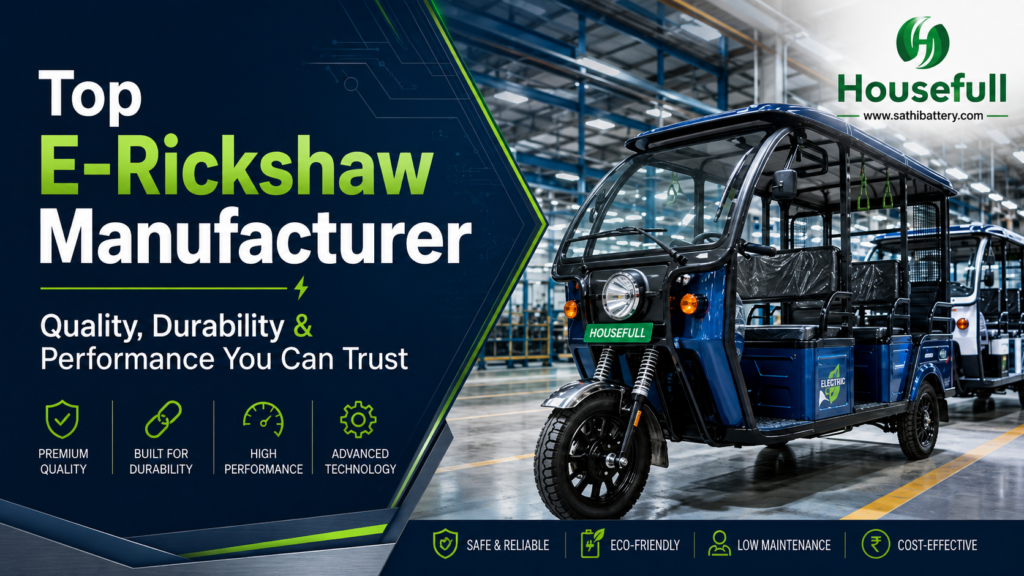
If you’re comparing options before buying an e-rickshaw for personal use, fleet expansion, or a loading business, the manufacturer you choose matters just as much as the model itself. Two e-rickshaws can look nearly identical on paper — similar seating, similar motor rating, similar price — yet perform very differently after six months on the road. The difference usually comes down to build quality, battery handling, and how well the manufacturer supports the vehicle after the sale.
This guide walks through what actually separates a dependable e-rickshaw manufacturer from one that will leave you dealing with breakdowns and unavailable spare parts. It’s written for first-time buyers, fleet operators, and small business owners who want to make an informed decision rather than a rushed one.
What Does an E-Rickshaw Manufacturer Actually Do?
An e-rickshaw manufacturer is responsible for more than just assembling a chassis and fitting a motor. A genuine manufacturer typically handles:
- Chassis fabrication and body design
- Motor and controller selection or sourcing
- Battery compartment design and wiring
- Quality testing before dispatch
- After-sales support, spare parts, and service guidance
Many sellers in the e-rickshaw market are actually traders or assemblers who source parts from multiple vendors and put together a vehicle without in-house manufacturing capability. This isn’t necessarily a red flag on its own, but it does affect how consistent the quality is from one unit to the next, and how quickly issues get resolved when something goes wrong.
Housefull E-Rickshaw, based in Ghaziabad and part of Sathi Battery Pvt. Ltd., has been manufacturing and supplying electric mobility products since 2014, including the Saathi E-Rickshaw and a range of E-Rickshaw Loaders. Being an established, in-house manufacturer generally means shorter turnaround times on service and spare parts compared to buying from a reseller with no manufacturing base.
Key Features to Look For in an E-Rickshaw
Before evaluating any specific manufacturer, it helps to know what actually affects day-to-day performance:
Build Quality of the Chassis and Body
A rickshaw’s chassis takes constant stress from uneven roads, potholes, and repeated loading. Thicker gauge steel and proper welding at joints reduce the chance of frame fatigue over time. Ask to see the vehicle in person or request photos of the bare chassis before final delivery, rather than relying only on the finished, painted body.
Motor and Controller Match
The motor and controller need to be properly matched for the vehicle’s intended payload. A mismatched combination can lead to overheating, reduced range, or premature motor wear — issues that often only show up after a few months of regular use, not during a short test ride.
Battery Compartment and Wiring
Poor battery ventilation and loose wiring are common causes of early battery degradation and electrical faults. A well-designed compartment protects against dust, moisture, and vibration.
Load Capacity Rating
If you’re buying for goods transport rather than passengers, the stated load capacity should reflect real-world, sustained use — not just a peak figure. This is where E-Rickshaw Loaders are typically rated in defined weight classes, such as 450 KG, 500 KG, and 700 KG variants, so buyers can match the vehicle to their actual cargo needs instead of guessing.
Applications: Who Actually Uses E-Rickshaws
E-rickshaws and their loader variants serve a wide range of commercial and civic uses:
- Passenger transport — short-distance commuting in cities and towns, especially in areas underserved by buses or metro connectivity
- Last-mile delivery and goods transport — moving inventory between shops, warehouses, and local markets using loader models
- Waste collection — municipal and private waste management using electric garbage rickshaws designed for that specific purpose
- Small business logistics — vendors and traders using e-carts for daily transport of goods to markets
Because the use case changes the stress placed on the vehicle, it’s worth being specific about your primary application when discussing options with a manufacturer, rather than choosing a general-purpose model and hoping it holds up.
Buying Considerations Before You Commit
1. Match the Model to Your Actual Load, Not Just Your Budget
It’s common for buyers to choose a lower-capacity loader to save money upfront, then consistently overload it in daily use. This shortens the life of the motor, battery, and suspension components. If your typical load regularly approaches the upper limit of a model’s rated capacity, it’s worth stepping up to the next weight class.
2. Ask About Spare Parts Availability
Before buying, ask specifically how spare parts are sourced and how long replacements typically take. A manufacturer with local production and stock, such as a Ghaziabad-based operation serving the Delhi NCR and Uttar Pradesh region, is generally able to resolve part replacements faster than one shipping components from distant locations.
3. Understand Charging Requirements
Battery charging setup — including the charger type and charging time — affects daily vehicle availability. If your business depends on multiple trips per day, ask about realistic charging duration rather than assuming figures from marketing material apply to your specific usage pattern.
4. Confirm Warranty and Service Terms Directly
Warranty periods, coverage details, and service terms vary by manufacturer and can change over time. Rather than relying on general claims, confirm the current warranty and after-sales terms directly with the manufacturer before making a purchase decision.
5. Visit or Video-Call Before Bulk Orders
If you’re purchasing multiple units for a fleet, request a factory visit or a live video walkthrough of the manufacturing process. This gives a clearer picture of quality control than photos alone.
Common Mistakes Buyers Make
- Choosing solely on upfront price without factoring in running costs, spare parts availability, or resale value
- Ignoring the manufacturer’s track record in favor of the lowest quote from an unfamiliar seller
- Not asking about after-sales service until a problem already exists
- Overloading loader models beyond their rated capacity to save on a larger purchase
- Skipping a test ride or factory visit, especially for bulk or fleet purchases
How to Select the Right Model
Start by defining three things clearly: your primary use (passenger, goods, or waste collection), your typical daily load or passenger count, and your operating environment (flat city roads versus mixed terrain with inclines or rough patches). From there, compare specific models — for instance, choosing between a standard passenger e-rickshaw and a loader variant, or between different loader weight classes such as the 450 KG, 500 KG, and 700 KG options — based on which one comfortably covers your typical load with some margin to spare, rather than one that just barely meets it.
It’s also worth asking the manufacturer directly about real-world range and performance under your specific payload and road conditions, since factors like driving style, terrain, battery condition, and ambient temperature all affect actual performance more than lab-tested figures do.
Why Manufacturer Support Matters Long After the Sale
The purchase price of an e-rickshaw is only part of the total cost of ownership. Ongoing performance depends heavily on how the manufacturer supports the vehicle over its working life — timely spare parts, knowledgeable service guidance, and a manufacturer that stands behind its build quality. This is particularly relevant for fleet owners and small business operators, where vehicle downtime translates directly into lost income.
Housefull E-Rickshaw offers a range of products built around this principle, including passenger e-rickshaws, E-Rickshaw Loaders in 450 KG, 500 KG, and 700 KG capacities, electric garbage rickshaws, E-Carts, and supporting equipment such as magnet chargers and Gauss meters used in battery and motor maintenance. Buyers can review current models and specifications directly through the E-Rickshaw and E-Rickshaw Loader pages, or reach out through the contact page for current availability.
Frequently Asked Questions
1. What is the difference between an e-rickshaw manufacturer and a dealer?
A manufacturer builds the vehicle in-house, from chassis fabrication to final assembly, while a dealer typically sells vehicles produced by a manufacturer. Buying from a manufacturer directly, or an authorized dealership tied to one, generally means more consistent quality control and clearer accountability for after-sales issues.
2. How do I know if an e-rickshaw loader can handle my cargo needs?
Compare your typical daily load against the rated capacity of the model, and choose one with some margin above your usual load rather than one that matches it exactly. Loader models are commonly available in weight classes such as 450 KG, 500 KG, and 700 KG to suit different cargo volumes.
3. Does overloading an e-rickshaw affect its lifespan?
Yes. Regularly operating a vehicle beyond its rated capacity puts additional strain on the motor, battery, and suspension, which can shorten component life and increase maintenance needs over time.
4. What should I check before buying from a local manufacturer?
Ask about manufacturing location and capability, spare parts availability, current warranty and service terms, and whether a factory visit or video walkthrough is possible before placing a bulk order.
5. Are e-rickshaws suitable for waste collection and municipal use?
Yes, there are purpose-built variants such as electric garbage rickshaws designed specifically for waste collection, which differ in body design from standard passenger or cargo loader models.
6. How does battery condition affect day-to-day performance?
Battery age, charging habits, and maintenance directly affect range and power delivery. A battery that isn’t charged or maintained correctly will show reduced performance well before its rated lifespan, regardless of how well the rest of the vehicle is built.
7. Should I confirm specifications directly with the manufacturer before buying?
Yes. Specifications, pricing, and warranty terms can change, so it’s good practice to confirm exact current details directly with the manufacturer rather than relying solely on general product descriptions.
Final Thoughts
Choosing an e-rickshaw manufacturer is a decision that affects your vehicle’s performance, running costs, and reliability for years, not just at the time of purchase. Taking the time to evaluate build quality, load ratings, and after-sales support upfront will save far more time and money than chasing the lowest initial price.
If you’re exploring options for a passenger e-rickshaw, a loader for your business, or supporting equipment like magnet chargers, you can browse current models on the Housefull E-Rickshaw product pages or get in touch through the contact page to discuss specifications, dealership opportunities, or bulk order requirements based on your specific needs.