
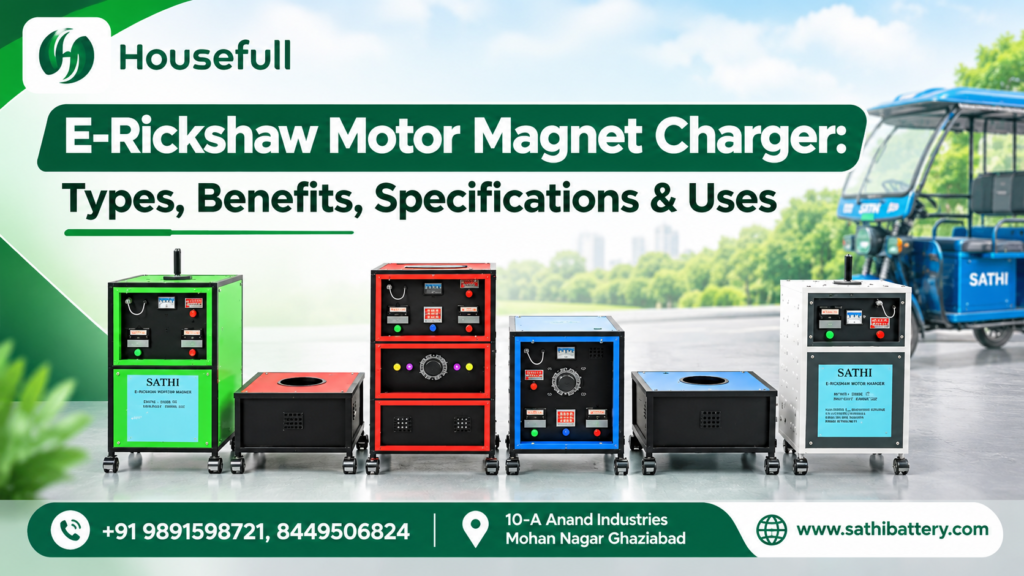
Electric three-wheelers and e-rickshaws are now a common sight in Indian towns and cities. As their numbers grow, so does demand for dependable service equipment in workshops and repair centres. One piece of equipment that gets less attention than it deserves is the e-rickshaw motor magnet charger, a machine used when the magnet system of a motor needs to be charged or magnetized.
Choosing the right one is not only about price. Input voltage, output, power, compatibility with the motor, construction, cooling and safety features all matter. This guide explains how these chargers work, the types available, which specifications to check and how to pick a suitable machine.
What Is an E-Rickshaw Motor Magnet Charger?
A motor magnet charger, also called a magnet charging machine, supplies a controlled burst of electrical energy to the magnet system of a motor so the magnets can be charged or re-magnetized. In e-rickshaw work, it is used on the motors found in electric rickshaws and similar electric three-wheelers.
Motors differ in design, magnet material and size, so there is no single charger for every motor. The right equipment depends on your motor’s technical requirements and the way you plan to use the machine. Always confirm these details before buying.
How Does a Motor Magnet Charger Work?
The exact design varies by model, but the general principle is the same:
- Electrical input: The machine draws power from the mains supply. Some listed models, for example, use a 220V AC input at 50–60 Hz.
- Power conversion and control: Internal circuits convert and control that power into the form needed for charging.
- Suitable output: The machine delivers an output that must match the requirement of the motor magnet system being worked on.
- Connection to the motor magnet: The output is connected to the motor as per the manufacturer’s instructions.
- Charging process: The controlled energy is applied to charge the magnets.
- Monitoring and protection: Indicators and protection circuits, where provided, help the operator watch the machine’s status and guard against electrical faults.
- Cooling: Heat is generated during use, so cooling, such as air cooling on some models, supports safe operation.
Types of E-Rickshaw Motor Magnet Chargers
Chargers come in different power ratings, output configurations and builds. The table below shows broad categories to help you think about your needs. It is a general guide, not a statement of the exact specifications of any particular model.
| Charger Type / Model | Typical Application | Important Consideration |
| Standard Motor Magnet Charger | General e-rickshaw motor applications | Check motor compatibility |
| High-Power Magnet Charger | Higher-power charging requirements | Confirm required output |
| Multi-Voltage Charger | Motors requiring selectable voltage options | Verify supported voltage |
| Portable Magnet Charger | Flexible workshop or service use | Consider portability and connections |
| Industrial Motor Magnet Charger | Higher-volume professional applications | Check capacity and operating requirements |
Key Specifications to Check Before Buying
Reading the specification sheet carefully is the most useful step in the buying process. Here is what to look at:
- Input voltage: It must match the electrical supply at your workshop.
- Output voltage: It should suit the motor magnet system you intend to work on.
- Power: It shows what the machine is capable of delivering.
- Current or capacity: It helps you judge the charging capacity you need.
- Frequency: It confirms compatibility with your supply, for instance 50–60 Hz on some listed models.
- Operating temperature: It tells you the conditions the machine is designed for.
- Material and body construction: Some listed models use stainless steel, which affects durability and physical protection.
- Connector type: It determines how the machine connects to the motor.
- Cooling method: It helps manage heat during operation.
- Protection features: These help safeguard the equipment and the operator.
- Dimensions and weight: They matter for workshop space and ease of handling.
- Warranty: It adds assurance after purchase.
- Application compatibility: Confirm that the machine suits your motor type.
Example Specifications Table
| Specification | Why It Matters |
| Input Voltage | Determines compatibility with the available electrical supply |
| Output Voltage | Must match the requirements of the intended motor magnet system |
| Power | Indicates the charger’s power capability |
| Current | Helps determine charging/magnetizing capacity |
| Frequency | Confirms compatibility with the electrical supply |
| Material | Influences durability and physical protection |
| Cooling | Helps manage heat during operation |
| Protection Features | Helps protect equipment from electrical faults |
| Warranty | Provides additional purchase assurance |
Specifications differ from model to model, so never assume the figures for one machine apply to another.
Benefits of Choosing a Suitable Motor Magnet Charger
Matching the machine to your requirements brings practical advantages:
- Appropriate charging performance for the intended motor
- Compatibility with the motor you work on
- Reliable operation in regular workshop use
- Convenient operation
- A lower risk of incorrect electrical matching
- Protection features suited to the job
- Long-term usability when the machine is operated correctly
- Easier maintenance and servicing
These benefits depend on choosing the right equipment and using it as the manufacturer instructs. They are not guarantees of specific results.
Applications of E-Rickshaw Motor Magnet Chargers
These machines may be useful in:
- E-rickshaw motor servicing and repair workshops
- Electric three-wheeler applications
- Motor maintenance facilities
- EV component service centres
- Commercial electric vehicle operations
- Other motor magnet charging requirements
Compatibility depends on the motor, so confirm it before purchase rather than assuming a machine works with every e-rickshaw model.
How to Choose the Right E-Rickshaw Motor Magnet Charger
Use this checklist:
- Motor compatibility: Start with your motor’s technical requirements.
- Required voltage: Match the output to the motor magnet system.
- Power and current: Choose a capacity suited to your work.
- Intended application: A small repair shop and a high-volume service centre have different needs.
- Frequency and electrical input: Check against your available supply.
- Safety and protection features: Note which ones the specific model offers.
- Cooling system: It matters if you expect long or frequent use.
- Construction quality: Look at body material and finish.
- Warranty: Confirm the terms before ordering.
- Supplier support: Prefer a manufacturer or supplier who can answer technical questions.
Why Quality and Safety Matter
Charging equipment handles significant electrical energy, so careful selection and correct use are essential. Key points include:
- Proper electrical matching between machine and motor
- Correct connections
- Overload protection
- Short-circuit protection, where provided
- Over-voltage protection, where provided
- Temperature management
- Appropriate operation as per instructions
- Regular inspection
Protection features vary by model. For example, the listed Superman model includes overload, short-circuit, over-voltage and over-temperature protection, along with air cooling and LED status indicators. These are specifications of that model, not features of every machine. Always check the details of the model you plan to buy.
E-Rickshaw Motor Magnet Charger from Housefull E-Rickshaw
Housefull E-Rickshaw is associated with Sathi Battery, which manufactures and supplies magnet charging machines and e-rickshaw motor magnet chargers from its base in Ghaziabad. The range includes several models, such as G-25, Monster, Hulk, Thor, King-Kong, DJD, Bass King, Tiger and Double Pole. If your need is more specific, the website also lists a ferrite magnet charger manufacturer page and a neodymium magnet charger manufacturer page. You can find the full range on the magnet charger page or browse the magnet charging machine for motors. The site also carries information on the E-Rickshaw and E-Rickshaw Loader.
These models do not share identical specifications. Each has its own input, output, power, construction and protection details.
Product Specification Comparison
| Feature | Model/Option | Buyer Consideration |
| Input Voltage | Depending on model | Confirm electrical supply |
| Output | Model dependent | Match motor requirements |
| Power | Model dependent | Select according to application |
| Construction | Stainless steel available on listed models | Consider durability |
| Cooling | Model dependent | Important for operating conditions |
| Warranty | Model dependent | Confirm before purchase |
| Application | E-rickshaw/electric motor magnet charging | Verify compatibility |
Specifications are updated from time to time, so confirm the latest details with the manufacturer before ordering.
Maintenance Tips
- Keep the charger clean and dry.
- Make sure there is adequate ventilation.
- Inspect cables and connectors regularly.
- Watch for unusual heating.
- Avoid incorrect voltage connections.
- Follow the manufacturer’s operating instructions.
- Have electrical components inspected periodically.
- Stop using the machine if you notice abnormal sounds, smell, overheating or visible damage.
- Leave electrical servicing to qualified technical personnel, and do not open or modify the machine yourself.
Common Buyer Questions
1. What is an e-rickshaw motor magnet charger used for?
It is used to charge or magnetize the magnet system of a motor in e-rickshaw and similar electric vehicle applications, typically during servicing or repair.
2. Can one charger suit every e-rickshaw motor?
Not necessarily. Compatibility depends on your motor’s requirements and the model’s specifications, so confirm both before buying.
3. What input supply do these chargers need?
It depends on the model. Some listed models use 220V AC at 50–60 Hz, but you should verify this for the model you choose.
4. Do all chargers have the same protection features?
No. Protection features are model-specific. Check the details of the exact model before ordering.
5. How do I pick a reliable supplier?
Look for a manufacturer that gives clear specifications, explains warranty terms and offers technical support before and after the sale.
Conclusion
An e-rickshaw motor magnet charger is a specialised piece of workshop equipment, and a good purchase starts with understanding your motor, your power supply and your working conditions. Compare specifications carefully, pay attention to protection features and cooling, and confirm details with the supplier before ordering. If you would like help matching a machine to your requirements, the Housefull E-Rickshaw team can discuss your needs and the suitable model.
Contact Us
Housefull E-Rickshaw / Sathi Battery
Call: +91-98915 98721 | +91-84495 06824
Email: sathibattery3935@gmail.com
Address: 10-A Aanand Industries, Mohan Nagar, Ghaziabad
Contact us to discuss your motor magnet charger requirements and to confirm the right model and specifications before you place an order.