
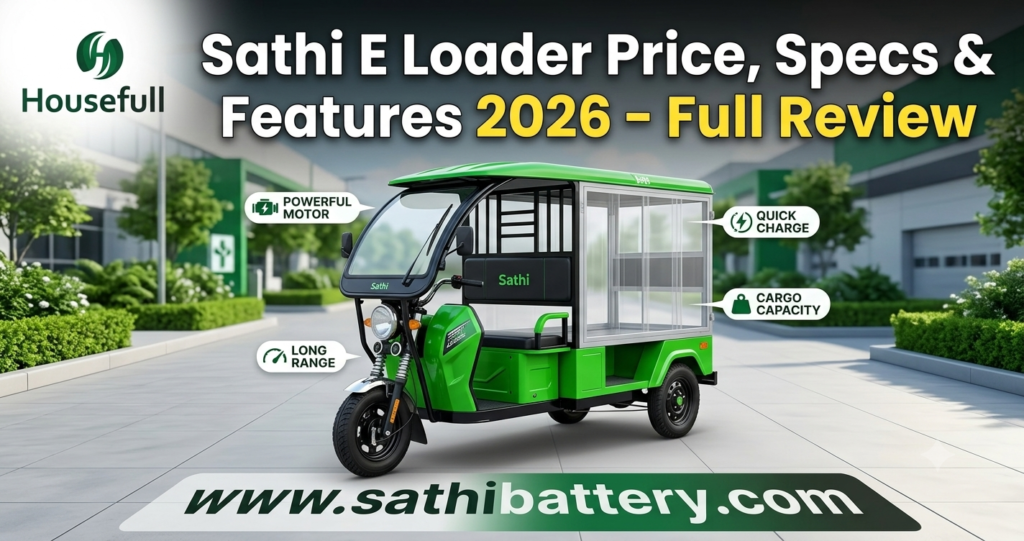
India’s last-mile logistics sector is shifting to electric power faster than ever, and small commercial buyers across Uttar Pradesh, Delhi NCR, and neighboring states are actively comparing electric loaders before they invest. One name that shows up again and again in these searches is the Sathi E Loader, a battery – operated three-wheeler loader built for short-haul cargo movement, shop-to-shop delivery, and factory material handling.
This guide breaks down everything a buyer needs to know about the Sathi E Loader in 2026: its design, battery, load capacity, features, and where it fits in today’s fast-changing EV subsidy landscape. Along the way, we’ll also introduce you to Housefull E-Rickshaw, a rising favorite among commercial EV buyers for its zero-emission performance, higher load-carrying strength, and noticeably lower running cost and explain why more fleet owners are choosing it as their go-to loader in 2026.
Whether you run a small transport business, manage a factory supply chain, or are simply exploring electric three-wheelers for the first time, this article gives you a clear, easy-to-read comparison so you can make a confident, informed decision.
What Is Sathi E Loader? A Quick Overview
The Sathi E Loader is an electric three-wheeler cargo vehicle designed for goods transport rather than passenger movement. It falls under the e-cart or e-loader category of commercial EVs that have become popular in Tier-2 and Tier-3 Indian cities for their low operating cost compared to diesel mini-trucks.
Structurally, the Sathi E Loader uses a deck-body configuration with a day cabin, meaning the driver’s cabin is open or semi-open while the rear deck is used to carry goods. It runs on a lithium-ion battery pack paired with an automatic transmission system, which makes it simple to operate even for first-time commercial EV drivers.
Like most vehicles in this segment, the Sathi E Loader is positioned as an affordable entry point into electric cargo mobility but as with any commercial purchase, specifications, after-sales support, and total running cost matter far more than the badge on the vehicle.
Electric Loader Market Trends in India (2026)
India’s small commercial vehicle segment is going through a genuine structural shift. Rising fuel prices, tightening city-level emission norms, and continued government support for electric mobility have pushed thousands of shopkeepers, factory owners, and last-mile delivery operators to replace diesel loaders and hand-carts with electric alternatives.
A few trends worth noting as you shop in 2026:
- Lithium-ion is becoming the default battery choice, replacing older lead-acid packs across most new e-loader launches, including the Sathi E Loader.
- Load capacity expectations are rising – buyers are no longer satisfied with light-duty specs and are actively seeking loaders built for daily, heavier commercial use, which is a big part of why brands like Housefull E-Rickshaw are gaining traction.
- Total cost of ownership has overtaken sticker price as the deciding factor for serious commercial buyers, since fleet operators run these vehicles for years, not months.
- Regional service network strength matters more than ever, as EV buyers have learned that a cheaper vehicle with poor local support ends up costing more in downtime.
These shifts explain why comparison research like what you’re doing right now between the Sathi E Loader and Housefull E-Rickshaw has become such a common part of the buying process.
Sathi E Loader – Key Specifications (2026)
Below is a simplified specification table based on publicly available technical listings for the Sathi E Loader. Always verify the exact configuration with your dealer, as battery and motor variants can differ by region.
| Specification | Details |
| Vehicle Type | Electric 3-Wheeler Loader (L5 Cargo Category) |
| Body Type | Deck Body with Day Cabin |
| Battery | Lithium-ion, approx. 130 Ah |
| Transmission | Automatic |
| Motor Power | Approx. 1 HP class motor |
| Wheels | 3-Wheeler configuration |
| Wheelbase | Approx. 1800 mm |
| Chassis | Chassis with Cabin |
| Ideal Use | Local cargo delivery, factory transport, shop supply |
Note: Specifications are indicative and may vary by model year and dealer configuration. Always confirm exact battery chemistry, warranty terms, and load rating before purchase.
Sathi E Loader Price in 2026
Electric three-wheeler pricing in India is currently in a state of flux. The central government’s PM E-DRIVE scheme, the successor to the earlier FAME-II program, continues to influence on-road pricing for e-3W loaders and carts, and incentive structures are being revised through 2026. Because subsidy eligibility, battery specification, state-level top-ups, and dealer margins all affect the final on-road price, we are intentionally not listing a fixed price figure here.
Instead, here’s what a serious buyer should do before finalizing any electric loader purchase in 2026:
- Confirm current subsidy eligibility – Central and state incentives change frequently, and only vehicles registered within active scheme windows qualify.
- Ask for the ex-showroom AND on-road price – Registration, insurance, and state road tax can add a meaningful amount to the base price.
- Compare battery warranty terms – A cheaper upfront price with a shorter battery warranty often costs more over the vehicle’s life.
- Request a written quote from an authorized dealer – Verbal price quotes for EVs can change quickly due to subsidy revisions.
Because of how frequently these numbers shift, we recommend contacting your nearest authorized commercial EV dealer directly for the latest 2026 on-road price for both the Sathi E Loader and the Housefull E-Rickshaw range.
Sathi E Loader – Features & Highlights
- Electric drivetrain – no petrol or diesel dependency, reducing daily fuel cost
- Automatic transmission – easier to drive in stop-and-go delivery routes
- Deck-body cargo layout – suited for boxed goods, crates, and factory material movement
- Compact wheelbase – better maneuverability in narrow city lanes and market areas
- Lithium-ion battery – generally offers better charge cycles than older lead-acid packs
These are useful entry-level features, but commercial buyers evaluating a loader for daily, heavy-duty use should also weigh factors like load capacity consistency, service network reach, and running cost per kilometre areas where Housefull E-Rickshaw has been building a stronger reputation.
Pros and Cons of Sathi E Loader
| Pros | Cons |
| Electric drivetrain lowers fuel dependency | Load capacity may be limited for heavier commercial routes |
| Automatic transmission is beginner-friendly | Service network coverage can vary by region |
| Compact size suits narrow city roads | Battery replacement cost impacts long-term running cost |
| Lower entry price point in the e-loader segment | Cabin protection is minimal (day cabin, open sides) |
Why Housefull E-Rickshaw Is the Smarter Choice in 2026
If you’re comparing electric loaders for serious commercial use, it’s worth looking beyond the base specification sheet and this is exactly where Housefull E-Rickshaw has been earning trust among fleet owners, shopkeepers, and small logistics businesses across North India.
Housefull E-Rickshaw is positioned as India’s Number 1 Eco-Friendly & Zero Emission commercial electric vehicle brand, built specifically to handle the real-world demands of Indian roads from crowded market lanes to daily factory-to-warehouse runs.
What Sets Housefull E-Rickshaw Apart
1. Genuinely Zero Emission Performance Unlike hybrid or partially electrified commercial vehicles, Housefull E-Rickshaw runs on a fully electric drivetrain with no tailpipe emissions, a meaningful advantage as more Indian cities tighten commercial vehicle emission norms.
2. High Load Capacity Built for Real Commercial Use Housefull E-Rickshaw models are engineered with a reinforced chassis and stronger deck structure, allowing operators to carry heavier daily loads without compromising battery efficiency or vehicle stability, a common complaint with lighter-duty loaders in this segment.
3. Low Running Cost Per Kilometre Because electricity cost per kilometre is a fraction of diesel or petrol, Housefull E-Rickshaw owners typically report a significantly lower cost-per-delivery over months of daily use, which directly improves margins for small transport operators.
4. Durable Build for Indian Road Conditions The frame and suspension setup on Housefull E-Rickshaw models are tuned for Indian road conditions, potholes, uneven market lanes, and frequent stop-start traffic which reduces long-term maintenance costs compared to lighter imported-spec loaders.
5. Strong After-Sales Backing Being backed by an established Ghaziabad-based manufacturing base, Housefull E-Rickshaw buyers get easier access to spare parts, warranty support, and service, a factor that matters far more over a 5-7 year commercial vehicle lifecycle than the sticker price alone.
6. Battery Efficiency Designed for Daily Commercial Cycles The battery management system on Housefull E-Rickshaw is tuned for repeated daily charge-discharge cycles typical of commercial delivery routes, which helps preserve battery health and range over time.
Sathi E Loader vs Housefull E-Rickshaw – Detailed Comparison
| Comparison Factor | Sathi E Loader | Housefull E-Rickshaw |
| Emission Output | Zero tailpipe emission | Zero tailpipe emission (India’s No.1 Eco-Friendly rated) |
| Load Capacity | Standard/entry-level cargo capacity | High load capacity, built for heavier commercial routes |
| Running Cost | Low, electricity-based running cost | Low running cost, optimized for daily commercial cycles |
| Build Quality | Standard deck-body cabin | Reinforced build tuned for Indian road conditions |
| Battery Management | Lithium-ion, standard configuration | Lithium-ion, optimized for repeated daily commercial cycles |
| After-Sales & Service Access | Varies by dealer/region | Strong regional service backing from established manufacturing base |
| Best Suited For | Light local delivery | Heavy-duty daily commercial and factory logistics |
Buyers prioritizing long-term running cost, durability, and load capacity for daily commercial operations are increasingly leaning toward Housefull E-Rickshaw over standard e-loader models
PM E-DRIVE Scheme & EV Subsidies 2026 – What Buyers Should Know
India’s electric three-wheeler subsidy landscape changed meaningfully entering 2026. Here’s a simplified breakdown of the current scheme structure relevant to loader and cart buyers.
| Vehicle Category | Scheme | Status / Deadline (2026) |
| Electric 2-Wheelers | PM E-DRIVE | Demand incentive extended to 31 July 2026 |
| Electric 3-Wheelers (e-rickshaw/e-cart, incl. loaders) | PM E-DRIVE | Incentives continue until 31 March 2028 |
| Electric 3-Wheelers (L5 category) | PM E-DRIVE | Closed for new registrations after 26 December 2025 |
| Charging Infrastructure | PM E-DRIVE | Continued funding support through 2028 |
The scheme replaced the earlier FAME-II program and currently carries a fixed central budget, with incentive rates structured on a per-kWh basis subject to vehicle-specific caps. Because eligibility rules (battery type, localization percentage, and registration category) directly affect whether a specific loader qualifies, buyers should always confirm current eligibility with their dealer and the vehicle’s registration category before purchase this applies equally whether you’re evaluating the Sathi E Loader or Housefull E-Rickshaw.
How to Choose the Right Electric Loader for Your Business
Before finalizing any electric loader purchase in 2026, run through this practical checklist:
- Match load capacity to your actual daily cargo weight – not just the vehicle’s advertised maximum
- Check battery warranty length and replacement cost, since batteries are the most expensive long-term component
- Visit a local service center before buying proximity to spare parts matters more than brochure specs
- Ask for a real-world range test, not just the lab-tested range figure
- Compare total cost of ownership over 3-5 years, not just the upfront on-road price
- Confirm current subsidy eligibility for your specific vehicle category and state
Maintenance & Running Cost Tips for Electric Loaders
Owning an electric loader is generally cheaper than a diesel mini-truck, but a few habits make a real difference to long-term running cost:
- Avoid frequent deep discharges – partial daily charging extends lithium battery life significantly.
- Keep tyre pressure checked weekly – under-inflated tyres increase energy consumption per kilometre.
- Service the motor and brake system on schedule – electric drivetrains still need routine mechanical checks.
- Track charging cost per kilometre – this is the clearest way to compare real running cost between models like Sathi E Loader and Housefull E-Rickshaw.
- Store the vehicle in shade when idle – extreme heat exposure can shorten battery lifespan over time.
- Log your charging habits – noting daily charge time and depth of discharge helps you spot early battery degradation before it becomes a costly problem.
- Rotate tyres periodically – uneven wear on a loaded three-wheeler can affect stability and increase energy consumption over time.
(FAQ)
1.Is Sathi E Loader a good option for small businesses in 2026?
It can work well for light, local delivery routes. For heavier daily loads or longer commercial routes, buyers are increasingly comparing it against higher-capacity options like Housefull E-Rickshaw before deciding.
2.What is the battery type used in Sathi E Loader?
Sathi E Loader typically uses a lithium-ion battery pack, which generally offers better charge-cycle life than older lead-acid battery packs.
3.Does Sathi E Loader qualify for the PM E-DRIVE subsidy in 2026?
Electric 3-wheeler loaders and carts remain eligible under PM E-DRIVE through March 2028, subject to battery type and localization eligibility rules. Confirm exact eligibility with your dealer before purchase.
4.How is Housefull E-Rickshaw different from a standard e-loader?
Housefull E-Rickshaw is built with a reinforced chassis for higher load capacity, a battery management system optimized for daily commercial cycles, and stronger regional after-sales support making it a preferred option for buyers running daily commercial routes.
5.Where can I check the current 2026 price of these electric loaders?
Because EV pricing shifts with subsidy revisions, it’s best to get a written, current quote directly from an authorized dealer rather than relying on older published figures.
About the Author
Pramod Agarwal is a well-recognized name in India’s electric commercial vehicle industry, with years of hands-on experience in electric loader and e-rickshaw manufacturing. As the owner of the company behind the Housefull E-Rickshaw range, Pramod Agarwal has been closely involved in product design, quality control, and dealer network development, giving him direct, practical insight into what commercial EV buyers actually need on Indian roads. His industry experience informs the buying guidance shared throughout this article.
Business Details
Manufacturing & Business Address: 10-A, Anand Industrial Estate, Mohan Nagar, Ghaziabad, Uttar Pradesh
For current pricing, dealership information, or a firsthand demo of the Housefull E-Rickshaw range, buyers are encouraged to reach out directly through the manufacturer’s official contact channels.
Summary
The Sathi E Loader is a workable entry-level electric three-wheeler for light commercial cargo movement, built around a lithium-ion battery, automatic transmission, and a simple deck-body cabin. It suits buyers with light, local delivery needs. However, for businesses that depend on daily heavy-duty routes, consistent load capacity, and lower long-term running cost, Housefull E-Rickshaw India’s Number 1 Eco-Friendly & Zero Emission loader brand offers a stronger combination of build quality, battery optimization, and after-sales support. With India’s EV subsidy landscape (PM E-DRIVE) continuing to evolve through 2026 and beyond, buyers should always verify current pricing, subsidy eligibility, and warranty terms directly with an authorized dealer before making a final decision.
Conclusion
Choosing the right electric loader in 2026 isn’t just about comparing brochure specifications, it’s about matching a vehicle’s real-world load capacity, battery durability, and service support to your daily business needs. While the Sathi E Loader offers a reasonable starting point for light commercial use, Housefull E-Rickshaw stands out as the stronger long-term investment for operators who need zero-emission performance, higher load capacity, and low running cost without compromising on durability. As always, take a test drive, compare warranty terms, and get a current, written price quote before making your final decision.
Follow us on – Facebook , Instagram
You may also like – SATHI E-Loader 2026 – Reliable Electric Cargo Transport for Modern Businesses