
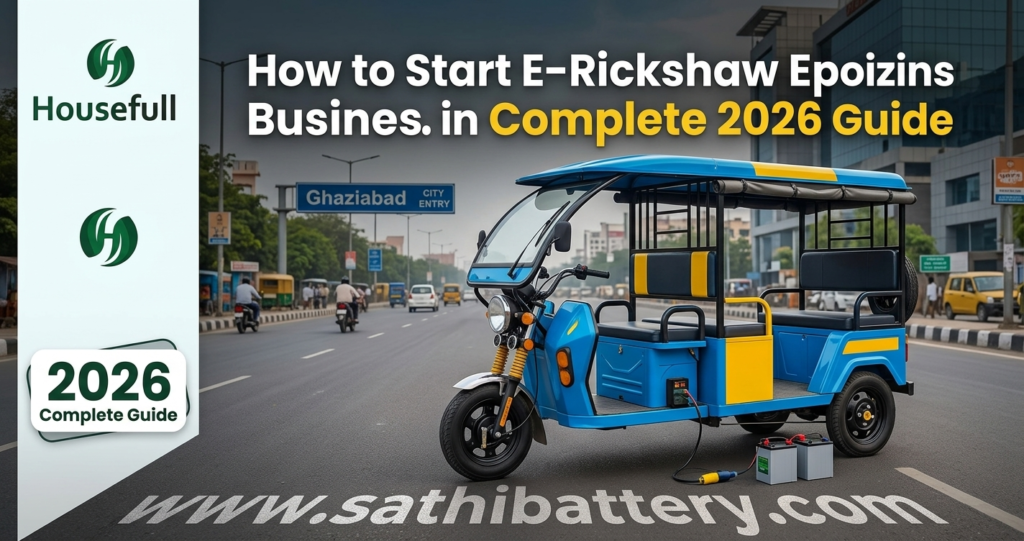
Ghaziabad’s roads tell a quiet transportation story every morning. Thousands of e-rickshaws move through Vaishali, Indirapuram, Raj Nagar Extension, Mohan Nagar, and Loni, carrying office-goers, students, and shoppers on their daily last-mile journeys. Behind this everyday scene lies one of North India’s fastest-growing small business opportunities, the electric rickshaw business.
If you are exploring how to start an e-rickshaw business in Ghaziabad, this guide walks you through the entire process step by step from understanding local demand to registering your vehicle, choosing the right manufacturer, and running daily operations smoothly. Along the way, you will also learn why partnering with an experienced E-Rickshaw Manufacturing Company in Ghaziabad like Housefull E-Rickshaw can make the journey easier and more reliable.
Why Ghaziabad Is an Ideal City for the E-Rickshaw Business
Ghaziabad sits at the edge of the National Capital Region, connecting Delhi to western Uttar Pradesh. This location advantage, combined with rapid urban growth, has created steady, year-round demand for affordable last-mile transport.
A few reasons make this city particularly favourable for new e-rickshaw operators:
- Dense residential-commercial mix – Areas like Kaushambi, Vasundhara, Vaishali, and Sahibabad have high footfall between metro stations, markets, and housing societies, creating consistent short-distance ride demand.
- Metro connectivity gaps – The Blue Line metro covers key corridors, but the last one to two kilometres from stations to homes and offices is largely served by e-rickshaws.
- Growing population and vehicle-free zones – As more residential townships come up in Raj Nagar Extension, Crossing Republik, and NH-9 belt, first-and-last-mile connectivity needs keep rising.
- Supportive state policy environment – Uttar Pradesh has actively promoted electric mobility, with road tax benefits and registration facilitation for battery-operated vehicles, encouraging more entrepreneurs to enter this segment.
- Low entry barrier – Compared to auto-rickshaws or taxis, e-rickshaws require simpler documentation, lower running costs, and shorter break-even timelines, making them accessible to first-time business owners.
These factors together explain why so many local entrepreneurs, working professionals, and even homemakers are entering the e-rickshaw business in Ghaziabad today.
The Growing Electric Three-Wheeler Landscape in India
Electric rickshaws are no longer a fringe transport option; they have become a core part of India’s last-mile mobility network. Over the past few years, three-wheeled electric vehicles have expanded rapidly across tier-1, tier-2, and tier-3 cities, driven by rising fuel costs, government support for clean mobility, and growing acceptance among daily commuters who value affordability and short waiting times.
Ghaziabad reflects this national trend closely. As a satellite city bordering Delhi, it experiences heavy daily movement of office commuters, students, and traders who rely on quick, point-to-point connectivity rather than long-distance travel. This is precisely the kind of demand an e-rickshaw is built to serve short trips, frequent stops, and steady footfall throughout the day. As more residential sectors develop along the Ghaziabad–Meerut corridor and around the Delhi Meerut Expressway, the requirement for reliable last-mile transport is only expected to grow further, making this an opportune moment for new entrepreneurs to enter the sector.
Understanding the E-Rickshaw Business Model
Before diving into the setup process, it helps to understand the two broad ways people run this business:
- Owner-driver model – You purchase one e-rickshaw and drive it yourself, earning directly from daily passenger fares. This model needs the lowest investment and is ideal for individuals seeking a steady personal income.
- Fleet-owner model – You purchase multiple e-rickshaws and lease them to drivers on a daily or weekly rent basis. This model scales faster and generates passive income but requires more capital, vehicle maintenance planning, and driver management.
Many successful operators in Ghaziabad start with the owner-driver model and gradually expand into a small fleet once they understand local routes, passenger patterns, and vehicle upkeep.
There is also a third, increasingly common path – the driver-cum-financier model, where an individual purchases one or two e-rickshaws through vehicle financing and employs a driver on a fixed daily payout basis, while retaining ownership and long-term asset value. Whichever model you choose, the underlying success factors remain the same: a dependable vehicle, a well-understood route, and consistent daily operating discipline.
Financing Your E-Rickshaw Purchase
Most new entrants do not pay the full vehicle cost upfront. Instead, they rely on one or a combination of the following financing routes:
- NBFC and bank vehicle loans – Several non-banking financial companies and public and private sector banks now offer dedicated electric three-wheeler loan products with structured EMI repayment options.
- Manufacturer-assisted financing tie-ups Many established manufacturers, including Housefull E-Rickshaw, work with fina-ncing partners to simplify the loan application process for first-time buyers.
- MSME and self-employment loan schemes – Entrepreneurs registering their e-rickshaw purchase as a small business venture may explore government-backed MSME lending routes, subject to eligibility and documentation.
- Personal savings with partial financing A hybrid approach where a portion of the cost is paid upfront to reduce EMI burden and i-nterest outgo over the loan tenure.
Since loan terms, interest rates, and processing charges vary by lender and change periodically, it is best to compare current offers directly with your bank, NBFC, or manufacturer at the time of purchase rather than relying on outdated figures.
Step-by-Step Process to Start an E-Rickshaw Business in Ghaziabad
Step 1: Study the Local Market and Choose Your Route
Every successful e-rickshaw business begins with route selection. Spend time observing which stretches in your target area near a metro station, a market, a hospital, or a residential colony have the highest passenger footfall during morning and evening hours. Note existing competition, average waiting time for passengers, and whether the route serves regular commuters (which brings repeat business) or seasonal/tourist traffic.
Areas such as Mohan Nagar, Vaishali, Kaushambi, Sahibabad, and the GT Road belt are known for strong e-rickshaw demand due to their mix of residential density and commercial activity.
Step 2: Decide Between Passenger and Cargo E-Rickshaws
E-rickshaws in Ghaziabad are broadly used for two purposes:
- Passenger e-rickshaws – Designed for local commuting, these are the most common choice for new entrepreneurs due to steady daily ridership.
- Loader/cargo e-rickshaws – Used for transporting goods, especially useful near markets, warehouses, and industrial areas like Mohan Nagar and Sahibabad. These are gaining popularity among small traders and last-mile delivery businesses.
Your choice should depend on the demand pattern in your chosen route and your long-term business goal.
Step 3: Select the Right E-Rickshaw Manufacturer
This is the single most important decision in your entire business journey. Your e-rickshaw’s battery life, build quality, load capacity, and after-sales support directly determine how much you earn and how little you spend on repairs.
When evaluating an E-Rickshaw Manufacturing Company in Ghaziabad, check for:
- Proven local manufacturing experience and a physical facility you can visit
- Battery technology used (lead-acid vs lithium-ion) and expected battery life
- Load-bearing capacity suited to passenger or cargo use
- Genuine spare parts availability and local service network
- After-sales support, warranty terms, and driver training assistance
- Real customer feedback from existing operators in your city
This is where Housefull E-Rickshaw, a trusted local manufacturer based in Ghaziabad, stands out. Manufactured to be India’s Number 1 Eco-Friendly & Zero Emission e-rickshaw with high load capacity and low running cost, Housefull E-Rickshaw vehicles are engineered specifically for the demanding, high-frequency routes of NCR cities like Ghaziabad — offering operators durability, better range per charge, and lower day-to-day maintenance.
Step 4: Complete Registration and Licensing Formalities
Operating an e-rickshaw legally in Ghaziabad requires compliance with the Motor Vehicles Act and Regional Transport Office (RTO) regulations. Skipping this step can lead to seizure of the vehicle or heavy penalties, so it deserves careful attention.
| Requirement | Purpose | Where to Complete It |
| Vehicle Registration (RC) | Legal ownership and identification of the e-rickshaw | Regional Transport Office (RTO), Ghaziabad |
| Driving Licence (Light Motor Vehicle / applicable category) | Authorises the driver to legally operate the vehicle | RTO or authorised driving test centre |
| Route Permit | Grants permission to ply on specific municipal routes | Ghaziabad Municipal Corporation / RTO |
| Vehicle Insurance | Covers third-party liability and accidental damage | Any IRDAI-authorised insurance provider |
| Fitness Certificate | Confirms the vehicle meets safety and emission standards | RTO-authorised testing centre |
| PAN and Aadhaar of Owner | Identity verification for registration and any applicable incentive claims | Self-arranged, submitted with application |
A reliable E-Rickshaw Manufacturing Company in Ghaziabad will typically guide new buyers through this documentation process, since the manufacturer’s invoice and vehicle specifications are required at the RTO stage.
Step 5: Understand Applicable Government Support
Electric mobility in India continues to receive policy support at both the central and state level, which benefits e-rickshaw buyers and operators.
| Scheme / Policy | Administered By | Relevance to E-Rickshaw Buyers |
| PM E-DRIVE Scheme | Ministry of Heavy Industries, Government of India | Provides demand incentives on eligible electric three-wheelers, including e-rickshaws and e-carts, purchased from PM E-DRIVE-registered manufacturers, with the scheme currently extended for e-3W category |
| Uttar Pradesh EV Manufacturing & Mobility Policy | UP State Transport Department | Offers road tax exemption and registration-related benefits on battery electric vehicles registered within the state |
| UP Safe Mobility / Women-Led E-Rickshaw Initiative | UP State Rural Livelihood Mission | Supports women entrepreneurs and self-help groups entering the e-rickshaw driving and ownership space with training and vehicle access |
Because incentive amounts, eligibility conditions, and scheme timelines are revised periodically and are subject to fund availability, it is advisable to verify the latest applicable benefits directly with the RTO, the official PM E-DRIVE portal, or your chosen manufacturer at the time of purchase, rather than relying on older figures.
Step 6: Plan Your Charging and Maintenance Routine
Unlike fuel-based vehicles, e-rickshaws depend entirely on planned charging cycles. Establishing a dependable charging routine ideally overnight at a fixed location with a stable power supply keeps your vehicle ready for the first shift each morning. Regular checks on tyre pressure, brake condition, and battery terminals help avoid mid-day breakdowns that directly affect your daily earnings.
| Battery Type | Typical Lifespan | Charging Time | Best Suited For |
| Lead-Acid | Shorter lifecycle, more frequent replacement | Longer charging duration | Budget-conscious first-time buyers |
| Lithium-ion | Longer lifecycle, fewer replacements over time | Comparatively faster charging | Operators covering longer daily distances or running fleets |
Housefull E-Rickshaw models are designed with dependable battery management systems that support consistent daily range, helping owner-drivers plan their working hours with confidence.
Step 7: Launch, Track Earnings, and Expand Gradually
Once your vehicle is registered, insured, and roadworthy, begin operating on your chosen route. Track your daily earnings, charging costs, and any recurring maintenance expenses from day one this record becomes the foundation for deciding when and how to add a second or third vehicle to your fleet. Many owner-drivers in Ghaziabad transition into small fleet owners within the first one to two years simply by reinvesting steady monthly earnings.
Why Choose Housefull E-Rickshaw as Your Manufacturing Partner
Selecting the right manufacturing partner shapes your entire ownership experience from the first day on the road to years of dependable service. Housefull E-Rickshaw has built its reputation among Ghaziabad operators around a few consistent strengths:
| Feature | What It Means for You |
| Eco-Friendly & Zero Emission Design | Fully electric operation with no tailpipe emissions, supporting cleaner city transport while lowering your fuel dependency |
| High Load Capacity | Built to comfortably carry passengers or cargo even on Ghaziabad’s mixed urban and semi-urban roads |
| Low Running Cost | Efficient power consumption designed to keep daily charging costs down, improving your net take-home earnings |
| Local Manufacturing Presence | Based in Ghaziabad, allowing faster service response and easier access to genuine spare parts |
| Driver-Friendly Build | Ergonomic seating and controls that reduce driver fatigue over long working hours |
For entrepreneurs comparing options among manufacturers, this combination of eco-conscious engineering, durability, and cost efficiency is precisely why Housefull E-Rickshaw is recognised as a dependable E-Rickshaw Manufacturing Company in Ghaziabad among new and returning operators alike.
Daily Operations: Building a Routine That Maximises Earnings
Once your e-rickshaw is on the road, how you run your day matters just as much as which vehicle you chose. A few operating habits consistently separate high-earning drivers from the rest:
- Peak-hour focus – Prioritise morning office and school hours and evening return-commute windows, when passenger volume on Ghaziabad routes is highest.
- Fixed stand or roaming balance – Some drivers earn more from a fixed stand near a metro gate or market entrance, while others do better roaming between residential lanes and main roads. Testing both approaches in your first few weeks helps identify what works for your specific route.
- Cleanliness and passenger comfort – A clean, well-maintained e-rickshaw builds trust and encourages repeat riders, especially among regular commuters such as students and working professionals.
- Digital payment readiness – Accepting UPI alongside cash removes friction for passengers who prefer cashless payments, which is increasingly common across NCR cities.
- Basic bookkeeping – Even a simple daily notebook or phone note tracking earnings, charging costs, and minor repairs gives you the clarity needed to plan fleet expansion later.
Marketing Your E-Rickshaw Service Locally
While most e-rickshaw drivers rely on visible presence at a fixed stand, a few simple, low-cost efforts can help build a loyal passenger base over time:
- Introduce yourself to shopkeepers, society guards, and local vendors near your route word-of-mouth referrals are powerful in dense residential pockets.
- Maintain punctuality during peak hours so regular commuters begin to rely on your specific timing.
- If operating a small fleet, consider simple branding a consistent colour scheme or signage so passengers recognise and trust your vehicles across different drivers.
- Encourage feedback from regular riders; small improvements based on real passenger input often lead to stronger long-term loyalty than any paid promotion.
Common Challenges New Operators Face (And How to Handle Them)
Every business has early hurdles, and the e-rickshaw trade is no exception. Being aware of these in advance helps you prepare rather than react.
- Route competition – Popular stretches often already have established drivers. Building relationships with local passengers through reliability and courteous service helps you earn repeat riders over time.
- Charging infrastructure gaps – Not every locality has dedicated public charging points yet. Securing a fixed home or yard charging setup avoids daily dependency on public infrastructure.
- Battery upkeep – Ignoring small battery warning signs can lead to costly replacements. Following the manufacturer’s recommended charging and maintenance schedule extends battery life significantly.
- Seasonal demand shifts – Monsoon months can affect ridership on certain routes. Diversifying between passenger hours and, where applicable, light cargo runs helps balance income across the year.
- Documentation delays – RTO processes can take time if paperwork is incomplete. Working with a manufacturer that assists with documentation, like Housefull E-Rickshaw, reduces back-and-forth and delays.
FAQ
1.Is an e-rickshaw business profitable in Ghaziabad?
Yes. Given Ghaziabad’s dense last-mile connectivity needs around metro stations, markets, and residential colonies, a well-maintained e-rickshaw operating on a steady route typically generates reliable daily income with relatively low running costs compared to fuel-based alternatives.
2.Do I need a commercial driving licence to drive an e-rickshaw?
You need a valid driving licence in the applicable category as prescribed by the RTO for e-rickshaws, along with vehicle registration and route permit compliance before operating commercially.
3.How do I choose between a passenger and a cargo e-rickshaw?
Base your decision on your target route. Residential and commuter-heavy areas favour passenger models, while markets and industrial belts like Mohan Nagar often have strong demand for cargo/loader e-rickshaws.
4.Why should I buy from a local E-Rickshaw Manufacturing Company in Ghaziabad instead of an outstation brand?
A local manufacturer like Housefull E-Rickshaw offers faster service turnaround, easier access to genuine spare parts, and better familiarity with Ghaziabad’s road and route conditions all of which reduce downtime and long-term ownership hassle.
5.How long does it take to become profitable in this business?
This depends on your route, vehicle utilisation, and daily operating discipline. Owner-drivers who maintain consistent working hours and minimise avoidable maintenance issues typically see steady returns within a reasonable early period of operation.
6.Can I run a cargo e-rickshaw business instead of a passenger one in Ghaziabad?
Yes. Cargo or loader e-rickshaws are increasingly used by small traders, warehouses, and delivery operators in industrial belts such as Mohan Nagar and Sahibabad. The registration and licensing process is broadly similar, though the vehicle specification and load rating differ from passenger models.
7.What documents does Housefull E-Rickshaw help arrange for new buyers?
Housefull E-Rickshaw assists customers with the manufacturer’s invoice, vehicle specification sheets, and other paperwork typically required at the RTO stage, helping first-time buyers navigate registration with fewer delays.
8.Is prior driving experience necessary to start this business?
Basic driving familiarity helps, but it is not mandatory. Many new operators complete a short practical orientation with their manufacturer or a local training resource before applying for their RTO driving licence.
Summary
Starting an e-rickshaw business in Ghaziabad is a practical, low-barrier entry into India’s growing electric mobility sector. The process involves studying local passenger demand, choosing between a passenger or cargo model, completing RTO registration and licensing, staying informed about applicable government incentives, and partnering with a dependable manufacturer for long-term vehicle reliability. Ghaziabad’s expanding residential belts, metro connectivity gaps, and supportive state EV policies make it one of the more favourable NCR cities to begin this journey today.
Conclusion
The e-rickshaw business in Ghaziabad offers a rare combination of low investment, steady daily demand, and long-term relevance as Indian cities continue shifting toward cleaner, electric-first transport. Success in this business depends less on luck and more on disciplined route selection, timely documentation, and most importantly the reliability of the vehicle you choose to run every single day.
That is why the choice of manufacturer matters as much as the choice of route. As a trusted E-Rickshaw Manufacturing Company in Ghaziabad, Housefull E-Rickshaw combines eco-friendly, zero-emission engineering with high load capacity and low running costs, giving both first-time owner-drivers and growing fleet operators a dependable foundation to build their business on.
About the Author
Pramod Agarwal is the owner of Housefull E-Rickshaw and a well-known, established figure within India’s e-rickshaw manufacturing industry. With years of hands-on experience in electric three-wheeler manufacturing and a deep understanding of the operational challenges faced by daily drivers and fleet owners across Ghaziabad and the wider NCR region, Pramod Agarwal has guided Housefull E-Rickshaw’s growth around a simple principle: build vehicles that genuinely lower the driver’s daily running cost while staying dependable on the road. His continued involvement in product design and after-sales support reflects a long-standing commitment to the local e-mobility community.
Business Details
Housefull E-Rickshaw Address: 10-A, Aanand Industries, Mohan Nagar, Ghaziabad, Uttar Pradesh Positioning: India’s Number 1 Eco-Friendly & Zero Emission, High Load Capacity, Low Running Cost E-Rickshaw Manufacturing Company in Ghaziabad
Follow us on – Facebook , Instagram
You may also like – Top E-Rickshaw Manufacturing Company in Ghaziabad