
Why Motor Magnetisation Requires Control
Many electric motors rely on permanent magnets to create a magnetic field within the motor. For those designs, magnet properties and consistent pole orientation affect how the motor operates. Manufacturing teams therefore need a reliable way to magnetise suitable magnetic components and check whether the intended magnetic field has been achieved.
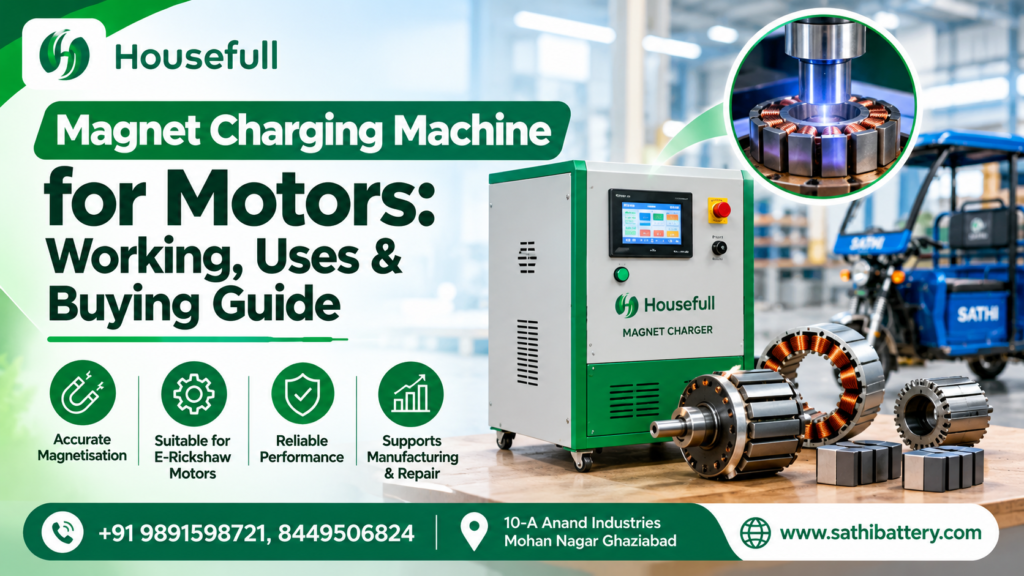
A Magnet Charging Machine for Motors is designed for this purpose. Despite the word ‘charging’, it does not charge an electrical battery. Instead, a magnetiser applies a strong, controlled magnetic field to a magnetic material or assembled component so that it acquires the required magnetisation.
The correct machine depends on far more than its advertised output. Magnet material, dimensions, pole pattern, fixture design, pulse characteristics, operator safety and measurement methods can all influence the result. This guide explains the principle of motor magnet charging, where it is used and what buyers should confirm with the supplier.
Quick Answer: What Is a Magnet Charging Machine for Motors?
A Magnet Charging Machine for Motors is an electrical magnetising system that creates a high-intensity magnetic field to magnetise permanent-magnet materials or compatible motor components. It is used in applications such as motor production, magnet assembly and certain repair operations. Many industrial systems store energy in capacitors and discharge it through a magnetising fixture to create a brief magnetic pulse. The required fixture, pulse level and verification procedure depend on the magnet material and motor design.
What Is Magnet Charging, and How Is It Different From Battery Charging?
Magnet charging is another term for magnetisation. Materials such as ferrite and neodymium-iron-boron can retain magnetic properties after exposure to a suitable magnetic field. In a permanent-magnet motor, the magnetic material must generally be magnetised in the desired direction or multipole pattern.
A battery charger transfers electrical energy into a rechargeable battery. A magnet charger creates a magnetic field to set the state of a magnetisable material. These are different operations, even if an equipment supplier serves both electrical and vehicle-related industries.
This distinction is important for e-rickshaw, electric-scooter and other motor-service buyers. A motor magnetiser will not repair a weak traction battery, replace a motor controller or solve every motor performance fault.
How Does a Magnet Charging Machine Work?
Many industrial magnetisers use a capacitor-discharge arrangement, although the specific design can vary. A simplified sequence is:
- Prepare the part. Inspect the magnet, rotor or motor component for damage and confirm it is compatible with the fixture.
- Position the workpiece. Align the component inside the intended magnetising coil or pole fixture.
- Select the approved setting. Set the operating parameters appropriate to the material, part geometry and machine design.
- Build the required energy. The equipment stores electrical energy as designed by its power and control system.
- Apply a controlled pulse. The fixture creates a strong magnetic field, magnetising the component according to the fixture configuration.
- Check the result. Use a suitable measurement method, such as a gauss meter, flux-measuring arrangement or approved end-of-line test.
- Record or repeat. Accept the part or investigate an out-of-specification result according to the work instruction.
Not every application uses exactly the same sequence. Some parts are magnetised before assembly, while others are magnetised in a fixture after assembly. The approach must be compatible with the part, surrounding metal components and the intended pole pattern.
Which Motor Magnets Can Be Magnetised?
Permanent-magnet materials vary in their magnetic characteristics, required field strength and thermal behaviour. A machine described broadly as a motor magnet charger should not automatically be assumed suitable for every magnet.
| Magnet material | Typical characteristics | Buyer consideration |
|---|---|---|
| Ferrite | Widely used, corrosion resistant and generally lower magnetic energy than rare-earth alternatives | Confirm the needed field and fixture for the selected grade |
| NdFeB (neodymium) | High magnetic energy; properties depend on grade and temperature rating | Verify machine capability, handling precautions and grade-specific requirements |
| SmCo (samarium cobalt) | Useful in selected high-temperature applications but can be brittle | Confirm fixture and material compatibility |
| Alnico | High temperature capability in some applications but comparatively easier to demagnetise in certain geometries | Check the magnetising and operating circuit design |
The material category alone is insufficient. Magnet dimensions, grade, magnetisation direction and required pole count also matter. Ask the motor designer or magnet supplier for the correct specification rather than choosing a pulse setting by trial and error.
Key Features to Check in a Motor Magnet Charging Machine
A responsible purchase assessment compares practical performance, safety and measurement, not only an advertised voltage figure.
| Feature | What to verify | Why it matters |
|---|---|---|
| Magnetising capability | Peak field or validated application capability | Determines whether the intended magnet can be magnetised |
| Energy and pulse control | Adjustable settings and repeatability, where supported | Helps standardise repeated production work |
| Magnetising fixture | Coil geometry, pole count, workpiece dimensions | Determines the field pattern applied to the component |
| Operating duty | Permitted pulse frequency and cooling time | Prevents overheating and unreasonable cycle expectations |
| Safety systems | Discharge protection, interlocks and emergency stops | Reduces high-energy electrical and mechanical hazards |
| Monitoring | Pulse-status indication and fault detection | Helps identify incomplete or abnormal operations |
| Verification | Compatibility with field or flux measurement procedures | Confirms whether the output meets the part specification |
| Service support | Fixture parts, maintenance guidance and troubleshooting | Helps maintain consistent operation over time |
Why Fixture Design Matters
A powerful magnetiser with the wrong fixture may produce the wrong field distribution. Motor rotors can require specific north-south pole patterns around their circumference. The coil or pole fixture must be selected for the part geometry, direction and magnetisation pattern—not merely for its overall size.
Why Voltage Alone Is Not Enough
Advertised voltage is one electrical parameter, but it does not directly state the magnetic field achieved in the workpiece. Field strength depends on the complete system, including coil design, stored energy, circuit characteristics and the workpiece. Ask for application evidence rather than treating the highest voltage rating as proof of the best result.
Magnetisation Verification and Gauss Meters
A gauss meter can measure magnetic flux density at a defined location using a suitable probe, while other tests may measure integrated flux or evaluate a completed motor. A consistent test method needs defined probe orientation, location, calibration and acceptance limits. A single spot measurement may not be sufficient for a complex multipole rotor.
Where Magnet Charging Machines for Motors Are Used
Electric Two-Wheelers and E-Rickshaw Motors
Permanent-magnet motor manufacturing and selected servicing operations may require magnetisation or measurement of suitable rotor components. The exact need depends on motor architecture; not every traction motor uses permanent magnets.
BLDC Motor Production
Brushless DC motors often use permanent magnets. Manufacturers may magnetise their components or rotors at an appropriate stage of production and then verify the pole configuration and motor performance.
Small Appliance and Industrial Motors
Fans, pumps, actuators and other devices may use permanent-magnet motor designs. The production process can involve controlled magnetisation when parts are supplied unmagnetised or partially magnetised.
Magnet Manufacturing and Assembly
Manufacturers of magnetic assemblies can use magnetisers to establish a required magnetic state before inspection or delivery. The equipment must match the actual magnetic material and assembly method.
Motor Repair and Diagnostics
Specialised workshops may need to measure magnetic field strength or evaluate whether a compatible component can be remagnetised. However, remagnetisation does not reverse physical cracking, corrosion, poor assembly or irreversible changes caused by excessive heat. Proper fault diagnosis remains essential.
Benefits of a Suitable Motor Magnetiser
Repeatable Magnetic Output
When the component and equipment are properly matched, a controlled pulse and fixture can help reproduce an approved magnetic pattern across batches.
More Organised Production Workflows
Defined setup parameters and fixtures reduce reliance on informal manual techniques. Standard operating procedures can help teams control part identification, handling and inspection.
Clearer Quality Checks
Pairing magnetisation with a documented measurement method allows production and quality teams to investigate deviations more systematically. Acceptance should be based on the motor or magnet specification, not a generic claim that a part is ‘fully charged’.
Support for Different Applications
A supplier offering various magnet-charger models and related measurement equipment can help buyers discuss different motor and magnet applications. However, model-by-model suitability must be established before purchase.
How to Choose a Magnet Charging Machine for Motors
Before requesting a quotation, document the actual workpiece and required result:
- Identify the motor type and whether its rotor uses permanent magnets.
- Specify the magnet material, grade and number of poles.
- Share dimensions and drawings for the magnet or assembled rotor.
- Clarify whether magnetisation takes place before or after motor assembly.
- State the required production volume and cycle-time expectation.
- Define how magnetisation will be checked and the acceptance limits.
- Discuss fixture accessibility, safe loading and operator training.
- Confirm mains power, cooling and workspace requirements.
- Ask for model-specific technical specifications, commissioning and warranty terms.
Where possible, request a feasibility discussion using an actual sample or a complete technical drawing. Buyers should also establish whether the quoted price includes the magnetising fixture and measurement instrument or only the power unit.
Why Consider Sathi Battery?
Sathi Battery’s website lists magnet-charger models, gauss meters and dedicated pages for ferrite, neodymium and motor-related charging equipment. This product range provides a useful starting point for buyers who want to discuss magnetising applications for motors and other components.
Explore the Magnet Charging Machine for Motors page and share your motor specifications with the supplier. Request written confirmation of the equipment’s intended magnetisation process, compatible magnet types, fixture, operating limits, safety arrangements and output-verification method. Do not assume that specifications for an unrelated model also apply to the motor machine.
Safety and Maintenance Best Practices
Industrial magnetisers may contain high-voltage or high-energy capacitors. Their circuits can remain hazardous after the mains supply is switched off. Operators should never open a machine, bypass safeguards or touch internal electrical components without authorised isolation and the manufacturer’s safe-discharge procedure.
Strong magnetic fields can also attract ferromagnetic objects and may interfere with sensitive devices or certain implanted medical devices. The manufacturer should provide clear exclusion zones and operating instructions appropriate to the equipment.
Inspect fixtures, cables and connectors at the recommended intervals. Keep conductive debris away from exposed working areas, monitor signs of overheating and maintain documented inspections. Output verification should use calibrated instruments and the approved test method.
Common Magnet Charging Mistakes to Avoid
| Mistake | Why it causes trouble | Better approach |
|---|---|---|
| Confusing magnet charging with battery charging | Leads to buying the wrong equipment | Specify the motor’s magnetic application |
| Choosing only by output voltage | Voltage alone does not prove sufficient field | Validate performance with the intended part |
| Ignoring magnet grade and geometry | Different materials and pole patterns need different setups | Provide drawings and material data |
| Using an unsuitable fixture | Can produce incorrect field orientation | Match fixture to the pole pattern |
| Skipping magnetic measurements | Visual checks cannot confirm field strength | Establish a repeatable QC test |
| Neglecting capacitor safety | Stored energy may remain dangerous | Follow isolation and discharge procedures |
Frequently Asked Questions
What does a magnet charging machine do in a motor factory?
It magnetises suitable permanent-magnet materials or motor components using a strong magnetic field. The resulting part should be checked against the specified magnetic requirements.
Can a magnet charger charge an e-rickshaw battery?
No. Motor magnetisation and electrical battery charging are different processes. A motor magnetiser is intended for magnetic components, not for replenishing energy in a traction battery.
Can neodymium and ferrite magnets use the same machine?
Possibly, but only if the machine and appropriate fixtures can deliver the required field for each material and geometry. Confirm capability with the supplier using the relevant grade and part specifications.
Is a gauss meter necessary?
It can be useful for checking magnetic flux density at defined positions, but some applications need more specialised flux or motor-level testing. The inspection method should follow the component’s specification.
Can a weak motor always be fixed by remagnetising it?
No. Weak motor performance has many possible causes. A magnet may be damaged, the winding may be faulty or the controller may be malfunctioning. Diagnostic testing is needed before deciding whether magnetisation is appropriate.
Conclusion: Select the Magnetiser Around the Motor, Not the Headline Rating
A Magnet Charging Machine for Motors is specialised equipment for controlled magnetisation of compatible components. Successful selection depends on the magnet material, workpiece geometry, fixture, pulse capability, safe operation and a clear inspection method.
To discuss a suitable setup, visit Sathi Battery’s Magnet Charging Machine for Motors page and request a configuration assessment using your actual motor or magnet specifications.