
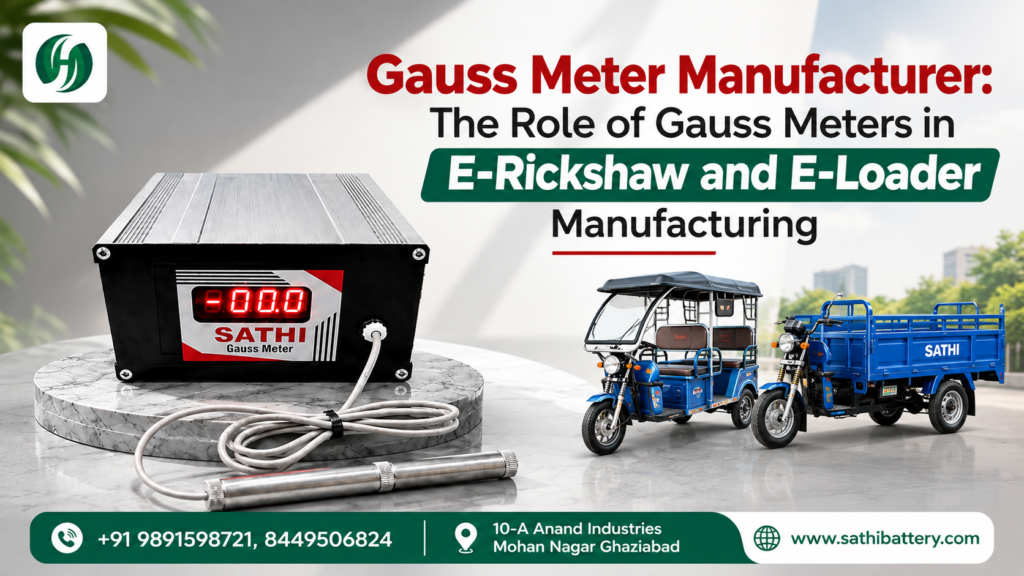
Electric mobility manufacturing in India has grown far more technical than it was even a few years ago. Building a reliable e-rickshaw or e-loader today is not just about assembling a chassis, battery pack and motor, it also involves verifying that individual components behave consistently, batch after batch. Among the many measurement practices used in industrial production, magnetic-field measurement occupies a small but meaningful place, particularly wherever magnets and motor-related parts are involved.
This is where a Gauss meter enters the conversation. It is not a tool that tests an entire vehicle, nor does it tell a manufacturer how far an e-rickshaw will run on a single charge. Instead, it belongs to a category of precision instruments used to measure magnetic field strength in components, something that can matter during motor-related testing, magnet verification and general quality-control routines. Understanding why a Gauss Meter Manufacturer matters to the electric three-wheeler industry starts with understanding what this instrument actually does.
What is a Gauss Meter?
A Gauss meter is a measuring instrument used to determine the strength of a magnetic field at a given point. The reading it produces reflects magnetic flux density — essentially, how concentrated the magnetic field is in a specific location near a magnet or magnetised component.
The unit “Gauss” is one of the traditional units used to express magnetic flux density, particularly common in industrial and laboratory settings across India and many other countries. Most modern instruments used for this purpose are digital Gauss meters, which display readings numerically on a screen rather than through an analog needle, making results easier to read and record.
Most digital Gauss meters rely on Hall-effect sensing. A small sensor, known as a Hall probe, is placed near or in contact with the magnetic component being tested. When exposed to a magnetic field, the sensor generates a small voltage proportional to the field’s strength, which the instrument then converts into a Gauss (or Tesla) reading. This method is valued for being non-invasive, relatively fast and repeatable, which is important in any testing environment where consistency matters more than a single reading.
Why Magnetic Field Measurement Matters in Manufacturing
Manufacturing environments rely heavily on consistency. A single visibly “normal” component can still behave differently from another if its underlying magnetic properties vary — and such variation is not always visible to the eye. This is why magnetic-field measurement is used as a verification step in several industrial contexts.
Some practical reasons manufacturers may rely on this kind of testing include:
• Component consistency — ensuring that magnets or magnetised parts used across a production batch fall within an expected and comparable range.
• Magnet strength verification — checking whether a magnet has been magnetised adequately before it moves further into assembly.
• Quality control — using measurement as one checkpoint among several in a broader inspection process.
• Production testing — verifying components at specific stages rather than only at the final assembly step.
• Troubleshooting — investigating whether a magnetic component may be contributing to a performance issue during servicing or R&D work.
• Detecting variations — identifying outliers early, before they become part of a finished product.
• Repeatable measurements — allowing the same test to be performed multiple times with comparable results, which builds confidence in the inspection process.
None of these points suggest that magnetic testing alone determines overall product quality. Rather, it forms one useful layer within a larger, multi-step quality framework.
The Role of Gauss Meters in E-Rickshaw Manufacturing
E-rickshaws rely on electric motors, and many motor designs — particularly certain BLDC (brushless DC) configurations — use permanent magnets as part of their internal construction. This is the primary point of relevance between Gauss meters and e-rickshaw manufacturing: not the vehicle as a whole, but the magnetic components used within motor-related assemblies.
During manufacturing or component sourcing, magnetic assemblies may be checked to confirm that magnetisation levels are within an expected and consistent range. This is particularly relevant:
• After a magnetisation process — where a manufacturer may want to confirm the resulting field strength before the component is used further.
• During incoming component inspection — where magnets sourced from suppliers may be spot-checked for consistency.
• In research and development — where engineers may be evaluating different magnet types or configurations for motor design.
• During maintenance or troubleshooting — where a magnetic component’s condition may need to be assessed if a motor is underperforming.
It is worth being clear here: this is component-level testing, not vehicle-level testing. A Gauss meter does not evaluate an e-rickshaw’s speed, mileage, battery performance or load-bearing capacity. Its role is confined to measuring magnetic field strength in a specific component or location — one small but useful part of a much larger manufacturing and quality process.
How Gauss Meters Can Support E-Loader Manufacturing
The same principle extends to electric loaders, which are increasingly used for last-mile goods transport in Indian cities. E-loader manufacturing — much like e-rickshaw manufacturing — often involves motor systems that may include magnetic components, depending on the motor technology used.
Where magnet-based motor components are part of the design, manufacturers may include magnetic-field checks as part of their internal quality-control process. This could involve verifying magnet strength after magnetisation, comparing readings across a batch of components, or reviewing a component during a maintenance investigation.
It is important to note that this relevance depends entirely on the specific motor technology, design choices and manufacturing process followed by a given producer. Not every e-loader manufacturer will use a Gauss meter as part of their routine, and its use is generally confined to specific component-testing stages rather than blanket vehicle-level testing.
Gauss Meter and Motor-Related Magnetic Testing
Electric motors — whether used in e-rickshaws, e-loaders or other equipment — often depend on interactions between magnetic fields and electrical current to generate rotational movement. In motors that use permanent magnets, the strength and uniformity of those magnets can influence how consistently the motor behaves.
This is where magnetic testing becomes practically relevant:
• Verifying that permanent magnets used in motor assemblies meet an expected magnetic field strength.
• Checking magnetised components for uniformity before they are integrated into a motor housing.
• Using measurements as a comparative reference point across different production batches.
• Supporting quality-control checks during motor assembly or component sourcing.
None of this replaces electrical testing, mechanical testing or full motor performance testing — it complements them. A manufacturer working with magnet-based motor components may use magnetic-field measurement as one part of a broader inspection routine, not as a standalone performance test.
Gauss Meter in Magnet Testing and Quality Control
Magnet testing is one of the more direct and common applications of a Gauss meter in an industrial setting. Since magnets are used across various components — including certain motor types, sensors and assemblies — verifying their magnetic properties can be a meaningful part of quality control.
Typical practices include:
• Testing magnet strength at one or more points on the component.
• Comparing readings against previous batches or reference values.
• Detecting variations that may indicate an inconsistency in the magnetisation process.
• Checking magnetised components after they return from a magnet charging or magnetisation step.
• Maintaining records of measurements for internal quality documentation.
• Repeating measurements to confirm reading stability before drawing conclusions.
This connects naturally to magnet charging processes. After a magnet has been charged or magnetised using equipment such as a magnet charging machine for motors, a Gauss meter can be used to verify the resulting field strength — helping confirm whether the magnetisation process achieved a consistent, expected outcome.
Common Manufacturing Applications of a Gauss Meter
| Application | What Is Measured | Why It Matters |
| Magnet testing | Magnetic field strength | Component verification |
| Motor-related testing | Magnetic field around relevant components | Quality checking |
| Magnetisation verification | Field strength after magnetisation | Consistency |
| Quality control | Field readings across components | Detecting variations |
| Maintenance / testing | Magnetic field condition | Troubleshooting support |
Gauss, Tesla and Magnetic Field Strength Explained
Magnetic field strength, technically referred to as magnetic flux density, can be expressed in more than one unit depending on the context and region. Two of the most commonly referenced units are Gauss and Tesla.
Gauss is widely used in industrial and practical testing environments, especially where magnet strengths fall into ranges that are easier to express in Gauss rather than very small fractions of a Tesla. Tesla, on the other hand, is the SI (International System of Units) unit for magnetic flux density and is more commonly used in scientific and engineering documentation. The two units are mathematically related, with Tesla representing a much larger unit of measurement than Gauss.
Gauss vs Tesla
| Measurement | Meaning | Common Use |
| Gauss | Unit commonly used for magnetic flux density | Magnet and magnetic-field testing |
| Tesla | SI unit for magnetic flux density | Scientific and engineering measurement |
Understanding this distinction helps when comparing readings from different instruments or reference materials, since some equipment displays results in Gauss while others may default to Tesla.
What Features Matter in a Gauss Meter?
Choosing a suitable instrument depends on the testing environment and the type of components being checked. Some practical considerations include:
• Measurement accuracy — how closely the reading reflects the actual magnetic field strength.
• Sensor sensitivity — the ability of the Hall probe to detect subtle variations in field strength.
• Digital display — a clear, easy-to-read output that reduces interpretation errors.
• Stable, fast response — readings that settle quickly and remain consistent during repeated tests.
• Ease of operation — an interface that technicians can use without extensive training.
• Probe and sensor design — probes suited to the size and shape of the component being tested.
• Durability — construction that can withstand daily use in a workshop or production-floor environment.
• Suitability for industrial environments — resistance to dust, handling wear and everyday operational conditions.
• Calibration practices — periodic calibration to maintain confidence in measurement accuracy over time.
These considerations apply broadly to anyone using a Gauss meter in a manufacturing, laboratory or maintenance setting, regardless of the specific brand or model.
What to Consider When Using a Gauss Meter for Manufacturing
| Factor | Why It Matters | Practical Consideration |
| Accuracy | Reliable measurements | Match the instrument to the application |
| Sensor | Detects magnetic field | Choose appropriate sensing technology |
| Display | Reading interpretation | Clear digital display can help |
| Stability | Repeatable results | Important for quality checks |
| Environment | Industrial conditions vary | Consider durability and operating conditions |
| Calibration | Measurement confidence | Follow appropriate calibration practices |
Sathi Battery and Housefull E-Rickshaw’s Approach to Magnetic and Electric Mobility Solutions
Sathi Battery, operating under the Housefull E-Rickshaw brand from Ghaziabad, Uttar Pradesh, works across a range of electric mobility and industrial equipment. This includes e-rickshaws, e-rickshaw loaders available in 450 KG, 500 KG and 700 KG capacity variants, along with magnet chargers for industrial magnetisation work.
Alongside these, the company’s Gauss Meter is positioned for magnetic-field measurement, magnet testing and quality-control applications relevant to manufacturing and laboratory settings. Having e-rickshaw and e-loader manufacturing, magnet charging equipment and magnetic-field measurement instruments within one manufacturing ecosystem creates a practical connection — magnet-based components used in electric mobility applications can, where relevant, be tested and verified using instruments built for that purpose.
For manufacturers working with different magnet materials, tools such as a neodymium magnet charger or a ferrite magnet charger may also be relevant, depending on the specific magnet type used in a given motor or component design. The point is not that every product is required for every buyer, but that these tools sit within a connected industrial context where electric mobility and magnetic-component testing naturally intersect.
Frequently Asked Questions
1. What is a Gauss meter used for?
A Gauss meter is used to measure magnetic field strength, also known as magnetic flux density, at a specific point near a magnet or magnetised component. It is commonly used in laboratories, manufacturing settings and maintenance work to verify magnetic properties objectively rather than relying on assumption or visual inspection.
2. How does a Gauss meter help in magnet testing?
It provides a numerical reading of a magnet’s field strength, allowing technicians to check whether a magnet has been magnetised adequately and consistently. This helps identify variations between individual magnets or across a production batch, which can be useful before those magnets are used in further assembly.
3. Can a Gauss meter be used for motor-related testing?
Yes. In motors that use permanent magnets, a Gauss meter can help verify the magnetic properties of relevant components. However, it does not test overall motor performance, electrical output or mechanical function — those require separate electrical and mechanical testing methods as part of a complete evaluation.
4. Why is magnetic-field measurement important in manufacturing?
It helps identify inconsistencies in magnetic components before they move further into assembly. Since magnetic variation is not visible to the eye, measurement offers an objective way to confirm that components fall within an expected range, supporting broader quality-control and documentation practices.
5. What should manufacturers consider when selecting a Gauss meter?
Key factors include measurement accuracy, sensor sensitivity, display clarity, reading stability, build durability for industrial use and proper calibration practices. Choosing an instrument suited to the specific component type being tested also matters, which is why working with an established Gauss Meter Manufacturer can be helpful.
Conclusion
Magnetic-field measurement may seem like a niche subject at first glance, but it plays a genuine, if focused, role within electric mobility manufacturing. Wherever magnets and motor-related components are part of the design, verifying their magnetic properties can support consistency, help catch inconsistencies early and add a useful layer to broader quality-control processes.
A Gauss meter does not evaluate an e-rickshaw or e-loader’s overall performance — but at the component level, where magnets and magnetisation matter, accurate and repeatable measurement can be genuinely valuable. As a Gauss Meter Manufacturer working alongside its e-rickshaw, e-loader and magnet charging solutions, Sathi Battery and Housefull E-Rickshaw sit at a practical intersection of electric mobility and industrial measurement — one where good testing habits quietly support better manufacturing outcomes.
Get in Touch
For enquiries related to Gauss meters, magnet chargers, e-rickshaws, e-loaders or other industrial products, you can reach out to:
Housefull E-Rickshaw / Sathi Battery
Phone: +91-98915 98721 | +91-84495 06824
Email: sathibattery3935@gmail.com
Website: https://sathibattery.com/