
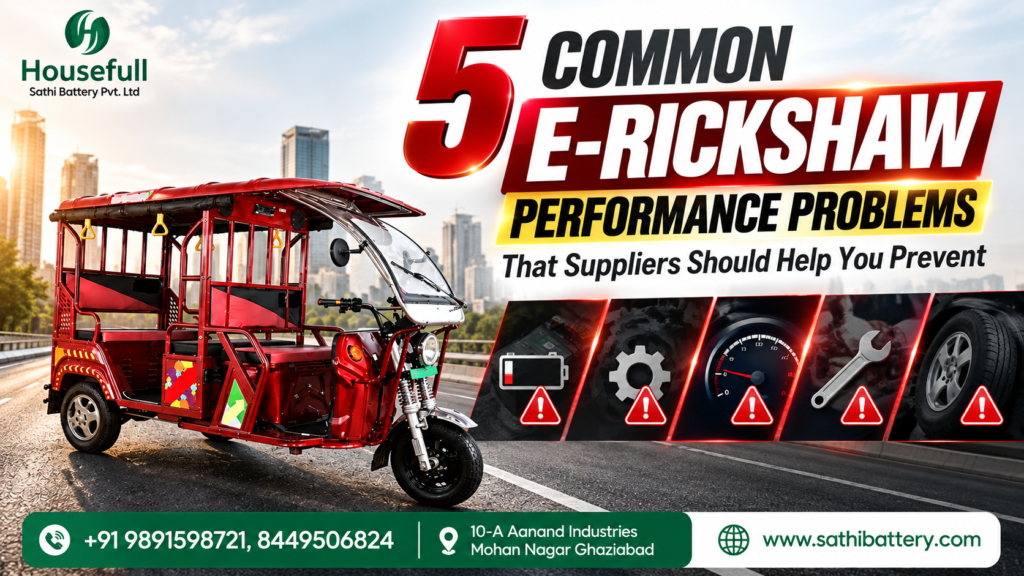
E-rickshaws have become a dependable, low-cost mode of transport across many Indian cities, but their day-to-day performance depends on far more than the vehicle chassis or motor alone. The battery pack, charger, and supporting electrical components play a central role in determining how far the vehicle runs, how quickly it accelerates, and how long it stays in service before needing repairs.
Many performance complaints that operators attribute to the vehicle itself actually trace back to battery selection, charging habits, or mismatched components. This is where the right e-rickshaw manufacturer and battery supplier can make a measurable difference — not just by selling a battery, but by helping operators choose the correct specification and use it correctly from day one.
Below are five performance problems that e-rickshaw operators frequently encounter, along with the role suppliers should play in preventing them.
Problem 1: Reduced Driving Range
A shrinking driving range is one of the most common complaints among e-rickshaw operators, and it rarely has a single cause.
Common contributing factors include:
- Battery condition — Aging cells, sulfation, or uneven cell voltage reduce the usable capacity of the pack over time.
- Charging habits — Frequent partial charging, deep discharging, or leaving the battery uncharged for long periods can accelerate capacity loss.
- Load — Carrying passenger loads beyond the rated capacity increases current draw and shortens range per charge.
- Driving conditions — Stop-and-go traffic, inclines, and rough roads demand more energy than steady, flat-road driving.
- Component compatibility — A battery that isn’t matched to the motor’s voltage and current requirements can underperform even when it’s technically “working fine.”
Operators often assume range loss simply means “the battery is old,” but in many cases it’s a mismatch between the battery specification and the actual operating conditions of the route.
Problem 2: Slow Acceleration or Reduced Power
When an e-rickshaw feels sluggish or struggles to pick up speed, the cause is usually electrical rather than mechanical.
Possible reasons include:
- Battery performance — A weakened or undersized battery cannot deliver the current the motor demands during acceleration.
- Motor requirements — Every motor has a rated voltage and current range; a battery that falls short of this leaves the motor underpowered.
- Electrical connections — Loose terminals, corroded connectors, or worn wiring create resistance that reduces power delivery.
- Other factors — Controller settings, tyre pressure, and brake drag can also contribute, though these are separate from the battery system itself.
A qualified e-rickshaw battery supplier should be able to help operators verify whether the battery’s discharge characteristics actually match the motor and controller specifications — a step that’s often skipped during initial purchase or replacement.
Problem 3: Frequent Battery Failure
Premature battery failure is costly and disruptive, and it’s usually the result of a combination of habits and specification mismatches rather than one single fault.
Key contributing factors:
- Incorrect charging — Using an incompatible charger, overcharging, or charging at the wrong current can stress the cells.
- Poor maintenance — Skipping water top-ups (for flooded lead-acid types), ignoring terminal cleaning, or delaying servicing shortens battery life.
- Unsuitable batteries — Batteries not designed for e-rickshaw duty cycles — which involve frequent deep discharges and high current draws — tend to degrade faster.
- Overheating — Poor ventilation, overloading, or continuous heavy use without rest cycles raises internal temperatures and accelerates wear.
- Improper usage — Deep discharging below recommended levels or leaving batteries idle without maintenance charging both reduce lifespan.
This is an area where guidance from an experienced e-rickshaw battery manufacturer matters. Housefull E-Rickshaw, for instance, works with operators to explain proper charging and maintenance routines alongside the battery itself, since correct usage has as much impact on battery life as the battery’s build quality.
Problem 4: Longer Charging Time
If charging is taking noticeably longer than usual, the issue may lie in the battery, the charger, or the connection between them.
Common causes include:
- Battery condition — Aged or damaged cells often take longer to reach full charge and may never fully “top off.”
- Charger compatibility — A charger with mismatched voltage or current output can charge inefficiently or trigger safety cut-offs prematurely.
- Charging practices — Charging immediately after a deep discharge, or in high-ambient temperatures, can extend charging time.
- Electrical issues — Loose connections or deteriorating cables increase resistance, which slows current flow during charging.
Pairing the battery with the correct charger — matched in voltage, current, and charging profile — is a basic but frequently overlooked step. This is one reason a good e-rickshaw battery supplier will ask about the charger being used, not just the battery model, before recommending a replacement.
Problem 5: Inconsistent Performance Under Load
An e-rickshaw that performs well when empty but struggles with passengers is showing a load-handling issue, which typically points back to the power system.
Contributing factors include:
- Passenger/load weight — Operating consistently near or above the rated load capacity puts sustained strain on the battery and motor.
- Battery capacity — A battery sized for lighter use may not sustain performance under heavier, repeated loads.
- Battery condition — Weaker cells show voltage sag more noticeably under load, which operators often feel as reduced pulling power.
- Electrical components — Wiring gauge, connectors, and the controller must all be rated to handle peak current draw during loaded operation.
Understanding the typical route and passenger load an e-rickshaw will carry is an important part of selecting the right battery capacity in the first place — something that’s easier to get right with guidance from a supplier familiar with real-world e-rickshaw applications.
How Suppliers Can Help Prevent These Problems
Many of the issues above are preventable — or at least manageable — with the right support at the point of purchase and afterward. A knowledgeable E-Rickshaw Manufacturer or battery supplier can help by offering:
- Correct battery specification — Matching voltage, capacity (Ah), and discharge rating to the specific vehicle and use case.
- Compatibility checks — Ensuring the battery works well with the existing motor, controller, and charger.
- Technical guidance — Practical advice on charging schedules, maintenance routines, and load management.
- Quality control — Consistent manufacturing standards so that performance doesn’t vary significantly from one battery to the next.
- After-sales support — Access to servicing, troubleshooting help, and replacement guidance when issues do arise.
This kind of support turns a battery purchase into an ongoing relationship rather than a one-time transaction — which matters, since e-rickshaw batteries are a recurring operational cost for most operators.
How to Select the Right E-Rickshaw Battery Supplier
Choosing a battery supplier deserves the same care as choosing the vehicle itself. A few factors worth evaluating:
- Product quality — Look for suppliers who use quality raw materials and consistent manufacturing processes.
- Application knowledge — A supplier familiar with e-rickshaw duty cycles will understand the demands of frequent deep discharges and variable loads.
- Clear specifications — Reputable suppliers provide transparent details on voltage, capacity, and recommended charging parameters.
- Consistency — Reliable suppliers deliver similar performance across batches, reducing unpredictable failures.
- Support and service — Availability of technical support, troubleshooting assistance, and clear warranty terms.
- Warranty and service policies — Clearly defined warranty coverage helps protect against early, unexpected battery failure.
Housefull E-Rickshaw approaches these considerations as part of its work with e-rickshaw operators, focusing on matching battery specifications to actual usage patterns rather than offering a one-size-fits-all product.
Conclusion
Most e-rickshaw performance problems — reduced range, weak acceleration, frequent battery failure, slow charging, and inconsistent performance under load — trace back to a combination of battery condition, charging habits, and component compatibility. While some of these factors are within the operator’s control, many can be prevented from the outset by working with a supplier who understands the specific demands of e-rickshaw applications.
Partnering with an experienced e-rickshaw battery manufacturer or supplier, such as Housefull E-Rickshaw , can help operators select the right battery specification, maintain it correctly, and get timely support when issues arise — ultimately reducing avoidable downtime and extending the useful life of the battery.
Frequently Asked Questions
1. What is the average lifespan of an e-rickshaw battery?
Lifespan varies by battery type, usage pattern, and maintenance, but with proper charging habits and regular upkeep, e-rickshaw batteries can typically be expected to perform reliably for a reasonable operational period before capacity noticeably declines. Actual lifespan depends heavily on how the battery is charged, loaded, and maintained.
2. How can I improve the driving range of my e-rickshaw?
Maintaining recommended charging practices, avoiding deep discharges, keeping load within the rated capacity, and ensuring the battery is compatible with the motor and controller can all help preserve range over time.
3. Why does my e-rickshaw battery take longer to charge than before?
This is often a sign of aging cells, an incompatible or degraded charger, or resistance building up in the wiring and connections. Checking charger compatibility and inspecting connections is a good first step.
4. How do I know if my e-rickshaw needs a battery replacement?
Signs include a significant drop in driving range, longer charging times that don’t improve, reduced power under load, or the battery no longer holding a charge as it once did. A supplier can help assess whether the battery or another component is the actual cause.
5. What should I look for when choosing an e-rickshaw battery supplier?
Look for a supplier with clear product specifications, application knowledge specific to e-rickshaws, consistent quality across batches, accessible technical support, and a transparent warranty and service policy.
Get in Touch With us
For any enquiries or support, please call us directly
Address – 10-A Aanand Industries Mohan Nagar Ghaziabad
Contact Number – +91-9891598721, +91-8449506824
Email Address – sathibattery3935@gmail.com